

Body Fat Percentage: Why Your Bathroom Scale Is Wrong.
A smart scale and a DEXA can disagree by 5–10 percentage points on the same person on the same morning. Here’s why — and what to actually trust.
Try the CalculatorIf you’ve ever stepped on a smart scale that claimed your body fat was 18% and then gotten a DEXA scan that said 24%, you’re not alone. Bathroom scales — even the expensive ones — systematically underestimate body fat for fit, muscular adults and overestimate for some others. The problem isn’t the brand. It’s the technology. Here’s why body fat percentage from a smart scale rarely matches reality, and what to use instead.
- Smart scales use bioelectrical impedance (BIA), which estimates body fat from electrical resistance through your feet.
- BIA accuracy: ±5–10% body fat. DEXA accuracy: ±1.5%.
- BIA gets influenced by hydration, recent meals, time of day, and even foot calluses.
- Use a smart scale for daily weight tracking. Use DEXA for actual body composition.
How smart scales estimate body fat
Smart scales use bioelectrical impedance analysis (BIA). A small electrical current passes from one foot through your body and back to the other foot. Different tissues conduct differently — water and lean muscle are good conductors, fat is a poor one. The scale measures resistance and uses an algorithm to estimate body fat from that resistance.
The technology works in principle. The problem is in practice:
- The current only travels through your legs and lower torso. Foot-to-foot scales never measure your arms, shoulders, or upper trunk. Whatever’s happening above your hips is extrapolated.
- Hydration drives the result. A 2% shift in body water can swing the body fat estimate by 2–3 percentage points. Dehydrated? Reading goes up. Just drank a litre? Reading goes down.
- The algorithms assume average body geometry. Tall, lean adults often get underestimated. Short, muscular adults often get overestimated.
What our DEXA data shows
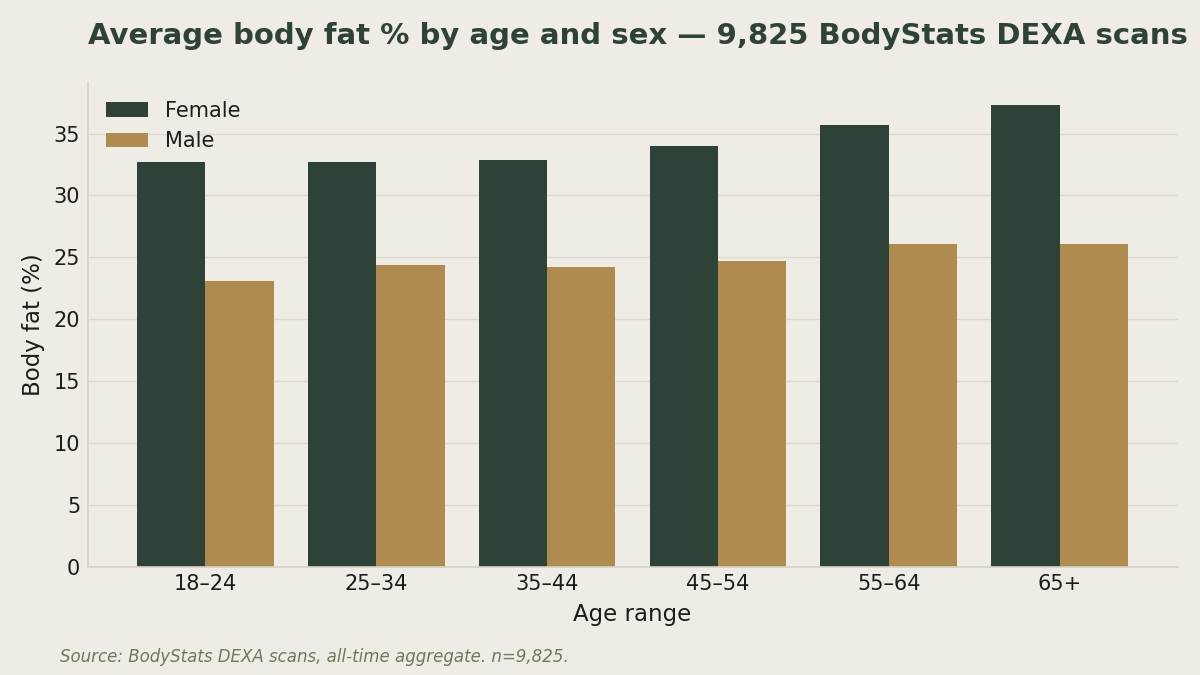
The averages give you a sense of where DEXA puts the population. Most clients walk in expecting their bathroom-scale number; most walk out with a DEXA reading that’s 3–8 percentage points higher. That’s not because DEXA is harsh — it’s because the scale was wrong.
Why DEXA reads higher than scales
Two structural reasons:
- DEXA sees your full body, including your arms and trunk. Foot-to-foot BIA misses the regions where many people carry significant body fat (e.g., the upper back, chest in men).
- DEXA measures fat directly via X-ray attenuation. BIA infers it from electrical resistance. The infer step is where the error accumulates.
For tracking your fat-loss or muscle-gain progress over time, the absolute number matters less than the consistency. A scale that’s wrong by the same amount each time can still show you a trend. The problem is that scale error varies daily — making the trend itself unreliable.
What to use bathroom scales for
- Daily weight — accurate enough.
- Trend tracking over weeks — the moving average smooths out daily noise.
- Hydration check — sudden weight changes are usually water.
What you actually need DEXA for
- True body fat percentage — known to ±1.5% rather than ±5–10%.
- Lean mass tracking — distinguish muscle gain from water/fat changes.
- Regional breakdown — where your fat actually sits, not a single body-wide number.
- Visceral fat — the metabolically active deep abdominal fat that BIA can’t see.
Use a scale for “am I drifting?” Use DEXA for “what’s actually changing?” They serve different purposes.
How to combine the two effectively
- Daily: step on the scale, log weight only. Ignore the body fat reading.
- Weekly: review your 7-day weight trend. Are you drifting up or down?
- Quarterly: get a DEXA scan to confirm what the scale was actually measuring (lost weight = lost fat? lost muscle? lost water?).
That cadence gives you tight daily feedback without trusting bathroom-scale body fat numbers. See our body composition methods comparison for the full breakdown of what each tool is good for.
Frequently asked questions
Are some scales more accurate than others?
Hand-to-foot scales (where you grip electrodes plus stand on them) are 10–20% more accurate than foot-to-foot. Still nowhere near DEXA, but better.
Should I trust the InBody at my gym?
Slightly more than a bathroom scale (it uses 8 electrodes vs 4). Still ±3–5% versus DEXA’s ±1.5%. Useful for trend, not for absolute number.
Why do some scales agree with my DEXA?
Coincidence. The expected error band is wide — some readings will land close to the true value just by chance. Not evidence the scale is reliable.
What’s the best body fat calculator?
Our body fat calculator uses the U.S. Navy method, which is more accurate than scale-based estimates. Still not as good as DEXA — book a scan if you want the real number.
Get the real number.
DEXA scan from $29.99 at BodyStats Vancouver or Toronto. Body fat to ±1.5%, regional breakdown, dashboard tracking.
Book a DEXA