

How Much Does a DEXA Scan Cost in Canada?
The same scanner. The same accuracy. Wildly different prices. We pulled real numbers from clinics across Vancouver, Toronto, Calgary, Edmonton, and Montreal — and the spread is bigger than you’d think.
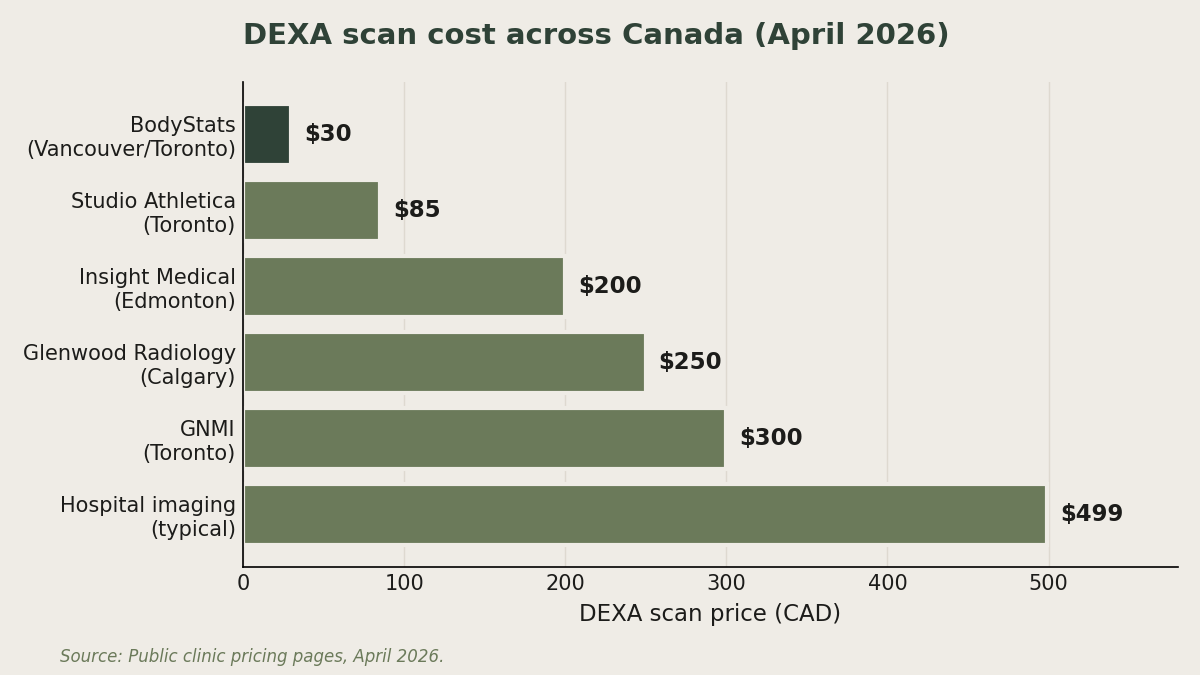
Book a ScanIf you ask three different Canadian clinics what a DEXA scan costs, you’ll get three different answers — and they can range from $29.99 to nearly $500 for what is, in most cases, the same machine running the same software. We pulled public pricing from clinics across Vancouver, Toronto, Calgary, Edmonton, and Montreal in 2026 to put together an honest answer to how much a DEXA scan costs in Canada in 2026, why prices vary so much, and how to know if you’re paying for accuracy or just paying for overhead.
- DEXA scans in Canada range from $29.99 (BodyStats) to $499+ (hospital-affiliated imaging).
- Most private clinics charge $150–$300 per scan.
- OHIP and most provincial plans cover bone-density DEXA scans (with a referral) but not body-composition scans.
- The scanner technology is essentially the same across most clinics. Price differences reflect business model, not accuracy.
What a DEXA scan costs across Canada in 2026
We surveyed clinic pricing pages and confirmed numbers by phone where they weren’t public. As of 2026:
| Clinic | City | Price (CAD) | Notes |
|---|---|---|---|
| BodyStats | Vancouver / Toronto | $29.99 | Hologic Horizon W. Online booking. No referral. |
| Studio Athletica | Toronto | $85 | Sports-medicine clinic; DEXA is one offering of many. |
| Bone Wellness Centre | Toronto | ~$150–$200 | Medical imaging clinic; pricing not public. |
| Insight Medical Imaging | Edmonton | ~$175–$225 | Multiple Edmonton-area locations. |
| Glenwood Radiology | Calgary | ~$200–$275 | Established imaging centre. |
| Radiomedic | Montreal | ~$200–$300 | Body-composition scans available with virtual consult. |
| GNMI | Toronto | $300 | Whole-body composition focus. |
| Hospital-affiliated imaging | Various | $300–$499 | Often requires referral; covered for bone mass only. |
The 17× price spread between the cheapest and most expensive Canadian options isn’t because some clinics are 17 times more accurate. It’s because of how each clinic structures its business.
Why DEXA scan prices vary so much
Three things drive the price you pay:
- Business model. Body-comp-focused clinics with online booking can scan dozens of clients a day at low margins. A multidisciplinary medical clinic that runs DEXA as one of fifteen services has higher per-scan overhead.
- Report depth. A basic body-composition report costs less than one with regional lean mass, visceral fat, and a physician’s interpretation. The hardware time is the same — the report-writing time is not.
- Insurance pathway. Bone-density DEXA scans (the original medical use case) are covered by OHIP, MSP, and most provincial plans with a doctor’s referral. Body-composition DEXA scans are private-pay across the board. Some clinics charge a higher cash price because they’re set up around insurance billing, not direct-to-consumer.
What actually drives accuracy (it’s not what you think)
Most people assume the price gap reflects an accuracy gap. It doesn’t — at least not directly. The hardware across most Canadian DEXA clinics is similar, and accuracy comes down to three things in this order:
1. How well the scanner is maintained
This is where we differentiate. We recalibrate every machine every single morning before the first client. We own our scanners outright (no leased hardware) and pay for full annual maintenance plans. If anything goes off-spec, our technician is on-site immediately — not “next available appointment in two weeks.” That’s the foundation.
2. Hardware family
The Hologic Horizon and GE Lunar iDXA are both high-precision scanners with sub-1.5% coefficient of variation. Differences exist (software algorithms, table speed, visceral-fat estimation) but they’re small. They don’t justify a 10× price difference.
3. The client (this is the biggest variable)
More than the hardware, more than the calibration, the single biggest source of variation between scans is what the client does before the appointment. Wearing different clothes (especially anything with metal or zippers), eating a large meal in the hours before, drinking a litre of water, exercising heavily — all shift the reading by enough to swamp the difference between a $30 scanner and a $500 scanner. The same person scanned twice in different states can read 1–2% body fat differently.
If you want consistent scan-to-scan results, the controllable variable isn’t which clinic you pick. It’s what you do in the four hours before you walk in.
What about insurance and provincial coverage?
This is where it gets a bit complicated:
- Bone-density DEXA scans are covered by OHIP (Ontario), MSP (BC), and most provincial plans for medically indicated reasons — for specific medical conditions. You’ll need a referral.
- Body-composition DEXA scans — the kind people get to track fat, lean mass, and visceral fat — are essentially never covered. Even when a hospital imaging centre runs the same scanner, body-comp falls outside the medically necessary indications.
- Private health benefits sometimes reimburse DEXA scans for a “wellness” or “diagnostic imaging” allowance. Check your benefits booklet. We can issue a paid receipt that’s accepted by most plans.
What you actually get for $29.99 at BodyStats
Some context for our pricing, which we get asked about constantly: we built BodyStats around a single product (body-composition DEXA), in two studios, with online booking. No insurance billing, no add-on services, no medical referrals. The scan itself takes seven minutes. We hand you a full report — body fat percentage, lean mass, visceral fat, regional breakdown — and walk you through it for 20 minutes. You leave with a PDF and access to our online dashboard. Same Hologic scanner family used at hospital imaging centres charging 10× more — but maintained to a standard that often exceeds them.
If you’d like to see what the report looks like before booking, we publish a sample DEXA scan report with every section labelled. The full price list is on our pricing page.
Should you pay more for a “better” scan?
Honest take: in our experience, the opposite is usually true. The more you pay for a body-composition DEXA scan in Canada, the more you’re paying for clinic overhead, physician margin, and insurance billing infrastructure — not better data, better tracking, or better insights. We think the $29.99 BodyStats scan is the best scan in the country, full stop.
Three reasons we’d argue that:
A full results dashboard, not just a PDF
Most clinics hand you the printed PDF the Hologic scanner generates by default and call it done. We log every scan to your BodyStats dashboard so you can pull up your last six scans on your phone and watch how your visceral fat, lean mass, and body fat percentage have moved over time.
Same-scanner peer comparison
Technical but important: cross-clinic comparison is unreliable because different scanners report visceral fat and segmental lean mass slightly differently. We compare your numbers against other clients scanned on the same machine — your percentile is real, not an artifact of a software difference between clinics.
BodyStats Insights
A short quiz built on top of your scan data that surfaces what to actually do next — based on your goals, training, sleep, and nutrition. Tailored to your numbers, not generic advice.
For $29.99, you walk out with a daily-calibrated, dashboard-tracked, peer-compared, insights-driven scan. We don’t know of a clinic charging more that delivers more.
What you should still compare across clinics:
- Calibration discipline. Daily? Weekly? Whenever someone remembers? Ask directly.
- Walkthrough quality. Are you handed a printout, or does someone explain it?
- Tracking infrastructure. Can you compare results over time, or is each scan an island?
- Booking and access. Phone tag and referrals, or online booking?
Frequently asked questions
Is a DEXA scan covered by OHIP or other provincial plans?
Bone-density scans, yes — with a referral. Body-composition scans (the kind that report your fat and lean mass), no. Body-comp DEXA is private-pay everywhere in Canada in 2026.
Why is BodyStats so much cheaper than other clinics?
Two reasons. First, we r