

Getting a DEXA Scan in Vancouver: Cost, Prep & Results
What DEXA measures, how to prepare, what your results include, and how to choose between BodyStats Gastown and Yaletown.
Book a Vancouver ScanA DEXA scan measures body fat percentage, lean mass, visceral fat, bone mass, and how each is distributed across your arms, legs, and trunk. This guide explains what the test measures, how to prepare, what affects cost, and what to expect from your results. BodyStats offers Vancouver appointments in both Gastown and Yaletown; compare both on our Vancouver DEXA scan locations page.
- BodyStats has two Vancouver studios: Gastown and Yaletown.
- Pricing can change by service or package, so check the current BodyStats pricing page before booking.
- For the most useful progress data, repeat scans under similar clothing, food, hydration, and time-of-day conditions.
- You don’t need a doctor’s referral. Book a DEXA scan online.
What a DEXA scan actually measures
A DEXA scan (short for Dual-Energy X-ray Absorptiometry) is the same imaging technology hospitals use for bone mass assessments. The scanner passes two low-energy X-ray beams across your body and measures how each beam attenuates through your tissues. Because fat, lean tissue, and bone all absorb X-rays differently, the machine separates them with high precision.
What you walk away with:
- Total body fat percentage — and the absolute mass of fat in pounds.
- Lean mass — every pound of muscle, organ, and water in your body.
- Bone mineral content — reported as part of your body composition.
- Visceral fat — the deep abdominal fat that wraps around your organs and matters most for metabolic health.
- Regional breakdown — fat and muscle in your left arm, right arm, left leg, right leg, and trunk, separately. This is the part that scales and InBody can’t give you.
The regional breakdown is where DEXA earns its reputation. If you’re cutting and losing more lean mass on one side than the other, DEXA shows it. No other tool at this price point does.
How accurate is a DEXA scan?
For body composition, DEXA’s coefficient of variation is typically under 1.5% — meaning if we scan the same person twice on the same day, the body fat reading rarely shifts by more than a percentage point. Compare that with the alternatives:
| Method | Typical precision | What to know |
|---|---|---|
| DEXA | High repeatability under consistent conditions | Reports total and regional fat, lean mass, and bone mass |
| BodPod | Can be repeatable with careful preparation | Estimates body composition from air displacement |
| InBody (gym BIA) | More sensitive to hydration | Fast and widely available |
| Skinfold calipers | Depends heavily on operator technique | Useful for trends when the same operator measures consistently |
| Bathroom scale | Best treated as a rough estimate | Convenient for frequent at-home tracking |
The practical implication: if you’re tracking a meaningful change — say, six pounds of muscle gain over a hard bulk — only DEXA reliably distinguishes that from water weight or measurement noise.
What actually drives a useful comparison
Repeat scans are easiest to compare when your preparation is consistent. Wear similar metal-free clothing, scan at a similar time of day, and keep food, hydration, and recent exercise as similar as practical. These variables can shift a reading enough to hide a small real-world change, regardless of which Vancouver studio you choose.
How much does a DEXA scan in Vancouver cost?
DEXA pricing varies by provider and by what the appointment includes. When comparing options, look beyond the scan fee: check whether you need a referral, whether a results walkthrough is included, how you receive your report, and whether repeat-scan packages are available.
BodyStats publishes current single-scan, package, and membership options on our pricing page. Choose Gastown or Yaletown in the booking flow to see current appointment availability; we avoid hard-coding a branch price here so this guide stays accurate when offers change.
What body fat percentage should you actually expect?
Most people walk in with a number in their head — the figure their bathroom scale or fitness tracker gave them — and walk out with a different one. Usually higher. Sometimes a lot higher. That’s not because DEXA is harsh; it’s because the alternatives systematically underestimate.
To set realistic expectations, here’s what 9,825 of our clients across all ages have averaged:
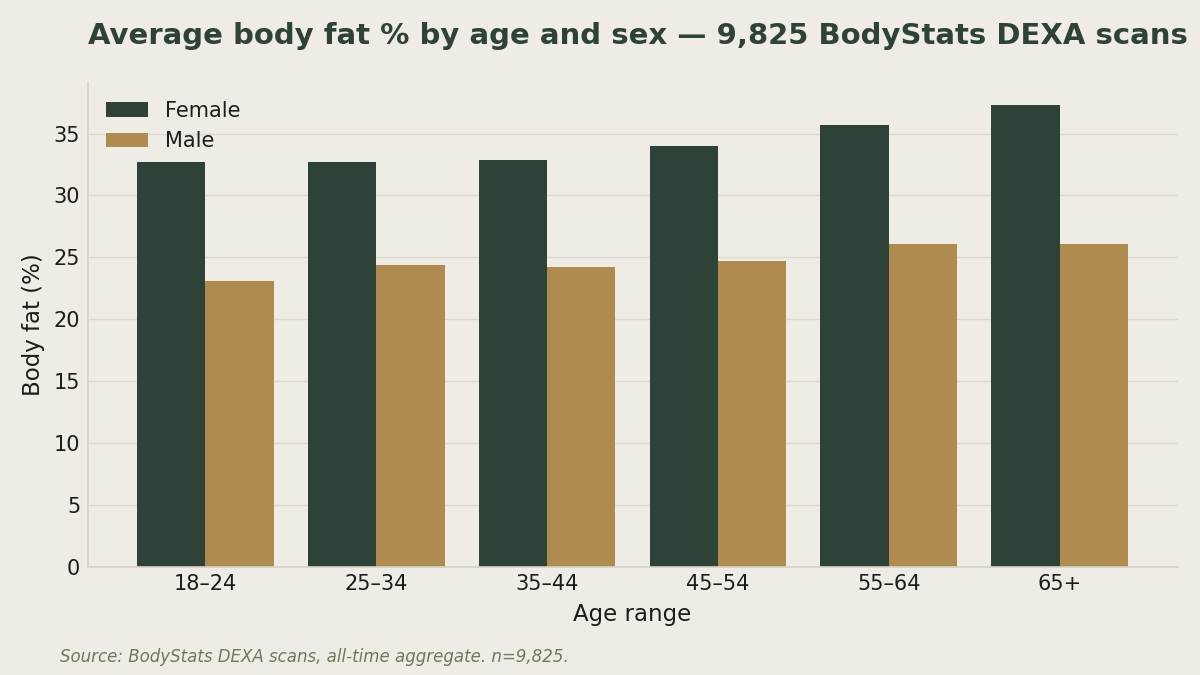
Two things stand out. First, the gap between men and women is ~10 percentage points across every age range — that’s biology, not behaviour. Second, body fat creeps up with age in both sexes, but slowly. The 35–44 cohort isn’t dramatically different from the 25–34 cohort. The bigger jump tends to come after 55.
Where you actually fall in this distribution matters more than the average — for that, we walk you through your full sample DEXA scan report at the end of every appointment, including age-matched percentile bands.
Choose a Vancouver studio: Gastown or Yaletown
BodyStats Gastown Dexa Scan Vancouver is at 316 Carrall Street, Vancouver, BC V6A 1K2, near Waterfront Station. BodyStats Yaletown Dexa Scan Vancouver is at 1118 Homer Street, Unit 114, Main Floor, Vancouver, BC V6B 2G2. Both can be compared on the Vancouver locations hub, including address details and the booking route.
What to expect at a BodyStats DEXA appointment
When you arrive:
- Check-in (3 minutes). A technician greets you, confirms your details, and walks you through what’s about to happen.
- Change into something metal-free (3 minutes). No underwire bras, no zippers in awkward spots. We provide a private changing area. (More on what to wear in our post on why metal matters during a DEXA scan.)
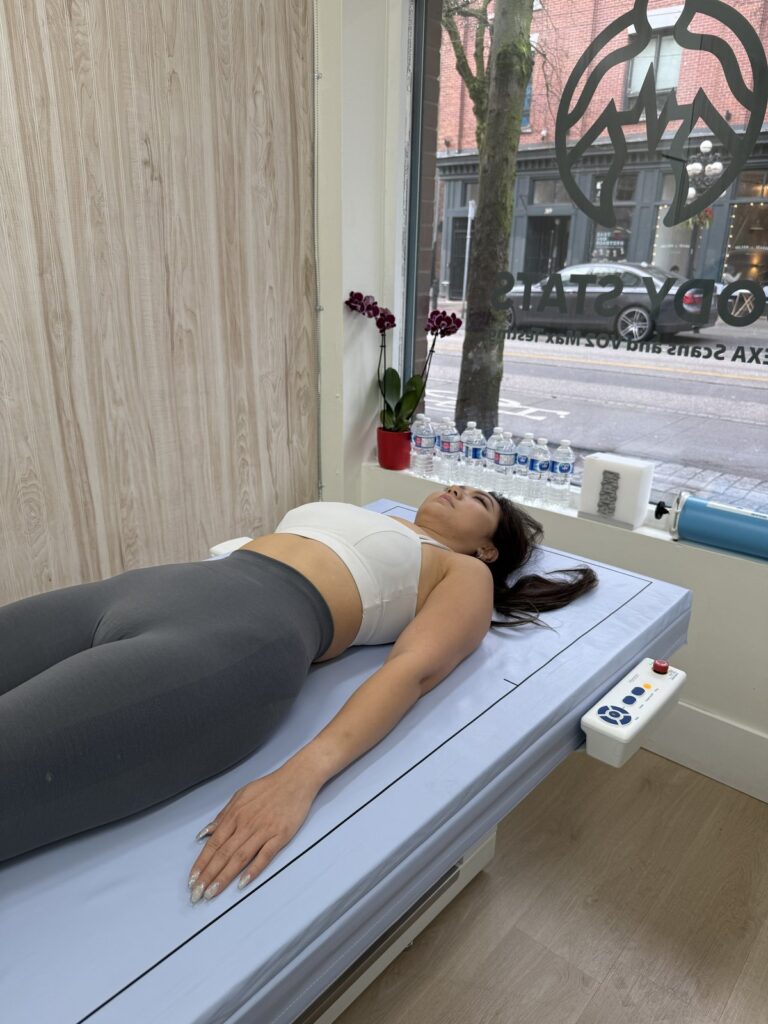
- The scan itself (about 7 minutes). You lie still on a padded table. A scanning arm passes over you slowly. There is no enclosed tube, no loud noise, no contrast injection. The radiation dose is roughly the same as a one-hour flight.
- Results walkthrough (15–20 minutes). Your technician opens your full report, explains every number, points out where you sit on the age-matched and young-normal percentile bands, and answers questions. We don’t hand you a printout and send you out — that’s the part most clinics skip.
Total time door-to-door: 30 minutes. You leave with a PDF of your scan and access to our online dashboard where every future scan is plotted against this baseline.
What is included with a BodyStats scan?
A DEXA appointment is more useful when the report is explained clearly and your future scans can be compared with the same baseline. BodyStats pairs the scan report with tools designed for ongoing tracking.
A full results dashboard, not a PDF
Every scan you do with us gets logged to your BodyStats dashboard. Open it on your phone, pull up your last six scans, watch your visceral fat, lean mass, and body fat percentage move over time. The PDF is still there — it’s just not the only thing you walk away with.
Same-scanner peer comparison
This is technical but it matters: cross-clinic comparison is unreliable because different scanners report visceral fat and segmental lean mass slightly differently. We compare your results against other clients scanned on the same machine, which removes that variable. Your “75th percentile” is real — not the artifact of a software difference between two clinics.
BodyStats Insights
A short quiz built on top of your scan data that surfaces what to actually do next — based on your goals, your training, your sleep, your nutrition. Not generic advice. Tailored to your numbers.
The most useful scan is one you can understand today and compare consistently over time.
Review the DEXA scan service page for appointment details, then check current pricing and choose the Vancouver studio that works best for you.
Who benefits most from a DEXA scan?
Honestly, the answer is “almost anyone who wants real data,” but a few groups get the most leverage out of it:
- Anyone trying to lose fat. Without DEXA, you can’t tell if the weight you’re losing is fat, muscle, or water. Scans every 8–12 weeks let you adjust your protein intake and training before you lose hard-earned muscle.
- Anyone in a hard bulk or recomposition phase. The opposite problem: scale weight goes up, but is it muscle? DEXA settles the question.
- Athletes and serious lifters. Regional breakdowns flag asymmetries before they become injuries.
- People over 40. Bone mass and visceral fat both become more important. DEXA gives you both, in one scan.
- People who’ve never tracked body composition. A baseline is a baseline. You can’t manage what you don’t measure.
Who probably shouldn’t book? People who are pregnant (we don’t scan pregnant clients — talk to your doctor), and anyone looking for a medical diagnosis rather than a body-composition measurement. If you have a medical concern, speak with a qualified healthcare provider.
How often should you scan?
Different goals, different cadence:
- Aggressive cut (1–1.5% body weight per week): every 4–6 weeks.
- Moderate cut or recomposition: every 8–12 weeks.
- Lean bulk: every 8–12 weeks.
- Maintenance / longevity tracking: every 6 months.
- Once-a-year baseline: reasonable if you’re not actively changing your physique.
If you scan more often than every 4 weeks, day-to-day measurement noise from water, glycogen, recent meals, and clothing can overwhelm the signal. Whatever cadence you choose, repeat the same preparation routine so your results are easier to compare.
Choose your Vancouver studio.
Compare Gastown and Yaletown, review current pricing, or book your DEXA scan online.
Compare Vancouver locations · View pricing · DEXA appointment details
Book a Vancouver Scan