

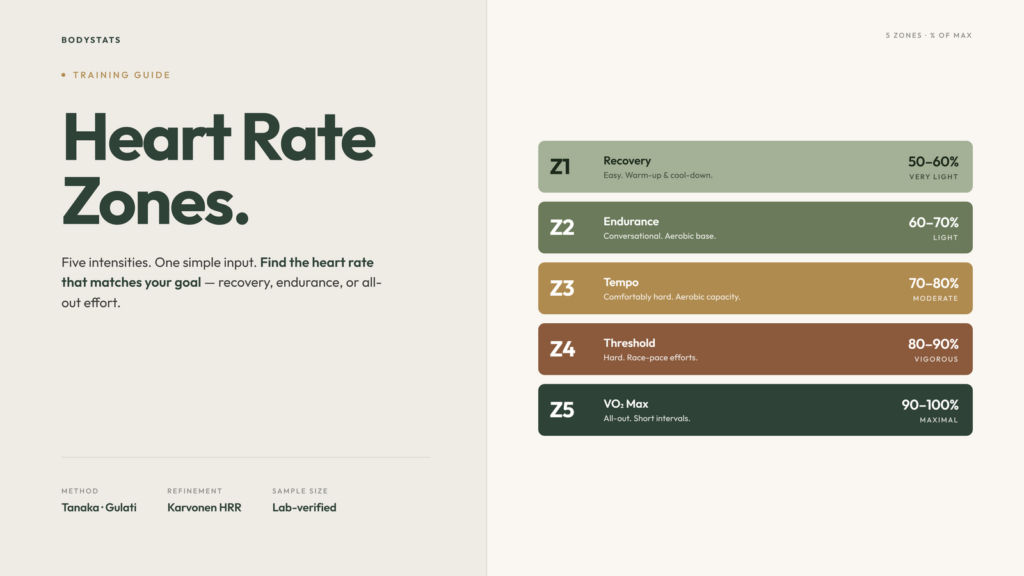
Your heart is the most honest training partner you have. Heart rate zones turn that signal into a plan — five intensities, each with a different physiological purpose. Recovery, fat oxidation, aerobic capacity, lactate threshold, and the ragged edge of VO2 max.
Most people train in the messy middle: too hard to recover, too easy to improve. Knowing your zones — and which one matches today’s goal — fixes that.
Heart Rate Zone Calculator
Uses the Tanaka formula for men and Gulati for women — the modern, research-backed replacements for 220 − age. Add a resting heart rate for sharper, Karvonen-based zones.
These are estimates. Get your true max heart rate and VO2 max measured in a real lab test.
Book a VO2 Max TestThe formula matters more than you think
For decades the gym poster read 220 − age. It’s still everywhere — and it’s quietly wrong. A 2001 meta-analysis by Hirofumi Tanaka and colleagues showed that the formula systematically overestimates max HR in young adults and underestimates it in older adults. Marcia Gulati’s 2010 study at Northwestern found the same pattern was sharper for women, who needed their own equation entirely.
Men (Tanaka): HRmax = 208 − (0.7 × age)
Women (Gulati): HRmax = 206 − (0.88 × age)
These are the formulas the BodyStats calculator above uses. Closer to reality than 220 − age, especially after 40.
Resting heart rate sharpens everything
A 35-year-old endurance athlete with a resting heart rate of 48 doesn’t train at the same bpm as a 35-year-old with a resting heart rate of 72. The Karvonen method — built on heart rate reserve (HRmax minus resting HR) — accounts for that gap.
If you enter your resting HR in the calculator above, it automatically switches to Karvonen. The zones tighten around your actual reserve instead of a population-average percentage of max.
Measure your resting heart rate first thing in the morning, lying still, before you check your phone. That’s your real baseline.
The five zones, in plain language
Percentages below are of max HR (or HRR if you used Karvonen). The descriptions are how each zone feels — that subjective check is just as important as the bpm.
Recovery
Easy walking, warm-up, cool-down. You should be able to breathe through your nose and hold a full conversation. Use this between hard sessions — it isn’t junk volume, it’s active recovery.
50–60% · Very lightEndurance
Conversational pace. The bread and butter of every endurance athlete — long runs, easy bike rides, base-building. Burns a high proportion of fat for fuel and builds mitochondrial density. Most people skip this zone; champions live in it.
60–70% · LightTempo
Comfortably hard. You can speak in short sentences. Sustainable for 30–90 minutes. Builds aerobic capacity and movement economy. Useful, but easy to overuse — too much Z3 leaves you flat for true threshold work.
70–80% · ModerateThreshold
Hard. Race-pace efforts for a 5K to 10K runner, hour-power for a cyclist. You’re at or just under your lactate threshold — the point where lactate production starts outpacing clearance. Use this 1–2 times per week, never more.
80–90% · VigorousVO₂ Max
All-out. Short repeated intervals, typically 30 seconds to 4 minutes, with full recovery between. Raises the ceiling of your aerobic engine. Brutal — and the most efficient way to lift your VO2 max if your base is already built.
90–100% · MaximalHow to actually use them
If you’re building a base: 80% of your training time in Z1–Z2, the remaining 20% split between Z4 and Z5. This is the classic polarized model — and it’s how most elite endurance athletes train.
If you’re losing fat: Z2 is your friend. Long, easy sessions burn a higher percentage of fat than short hard sessions. Combine with strength training and the right caloric deficit — use our TDEE calculator to find that number.
If you’re chasing performance: Add Z4 threshold work once a week and Z5 VO2 intervals every 7–10 days. Recovery is non-negotiable — your gains happen between sessions, not during them.
Stop estimating your max heart rate.
Formulas are a starting point. A BodyStats VO2 max test gives you your true max HR, your lactate-threshold heart rate, and your zones — measured in our lab, on the gas exchange analyzer.
Book a VO₂ Max Test