


The Right Way to Track a Lean Bulk.
Scale weight goes up. Is it muscle? Or fat? Or just a heavy meal still in your gut? Here’s how to actually track a bulk without lying to yourself.
Book a Bulk BaselineEvery fall, social media fills up with “bulking szn” posts. Most of them end the same way: by spring, the lifter looks heavier but has gained more fat than muscle. The problem isn’t effort or training — it’s measurement. Without real body-composition data, you can’t tell what’s actually happening to your body. Here’s how to track a lean bulk properly.
- Weigh-in scale alone is useless for bulk tracking — it can’t distinguish muscle from fat.
- Real lean-mass gain rate: 0.5–1 lb/month for most lifters past their first year.
- DEXA every 8–12 weeks confirms how much of your weight gain is muscle vs fat.
- Aim for a 70/30 muscle-to-fat ratio in gained weight.
What “lean bulk” actually means
A lean bulk is a deliberate calorie surplus aimed at muscle gain while minimizing fat gain. The math:
- Surplus: ~250–400 calories per day above TDEE.
- Protein: 0.8–1 g per lb of bodyweight.
- Training: heavy resistance training, 3–5 sessions per week.
- Sleep: 7+ hours. Most muscle protein synthesis happens at night.
The “lean” part requires that fat gain stay roughly proportional to muscle gain — typically a 70/30 muscle/fat ratio in the gained weight is realistic for most lifters past their first year.
Why the scale lies during a bulk
If you gain 5 lb on the scale across 8 weeks, that 5 lb could be:
- 5 lb muscle — ideal but rarely happens.
- 3 lb muscle + 2 lb fat — a successful lean bulk.
- 1 lb muscle + 4 lb fat — a sloppy bulk you should correct.
- 1 lb muscle + 2 lb fat + 2 lb water — what most “5 lb gains” actually are.
The scale can’t distinguish these. DEXA can.
“I gained 5 pounds this month” is not the same as “I built 5 pounds of muscle.” Without body-comp tracking, you’ll find out in spring — by which point you’ve added a lot of fat.
The cadence we recommend for bulkers
- Baseline scan at week 0 — establish where you start.
- Re-scan at week 8 — confirm the muscle-to-fat ratio of gained weight is reasonable.
- Re-scan at week 16 — adjust calorie surplus based on the trajectory.
- Final scan at the end of the bulk — quantify total gains and decide if you need a mini-cut.
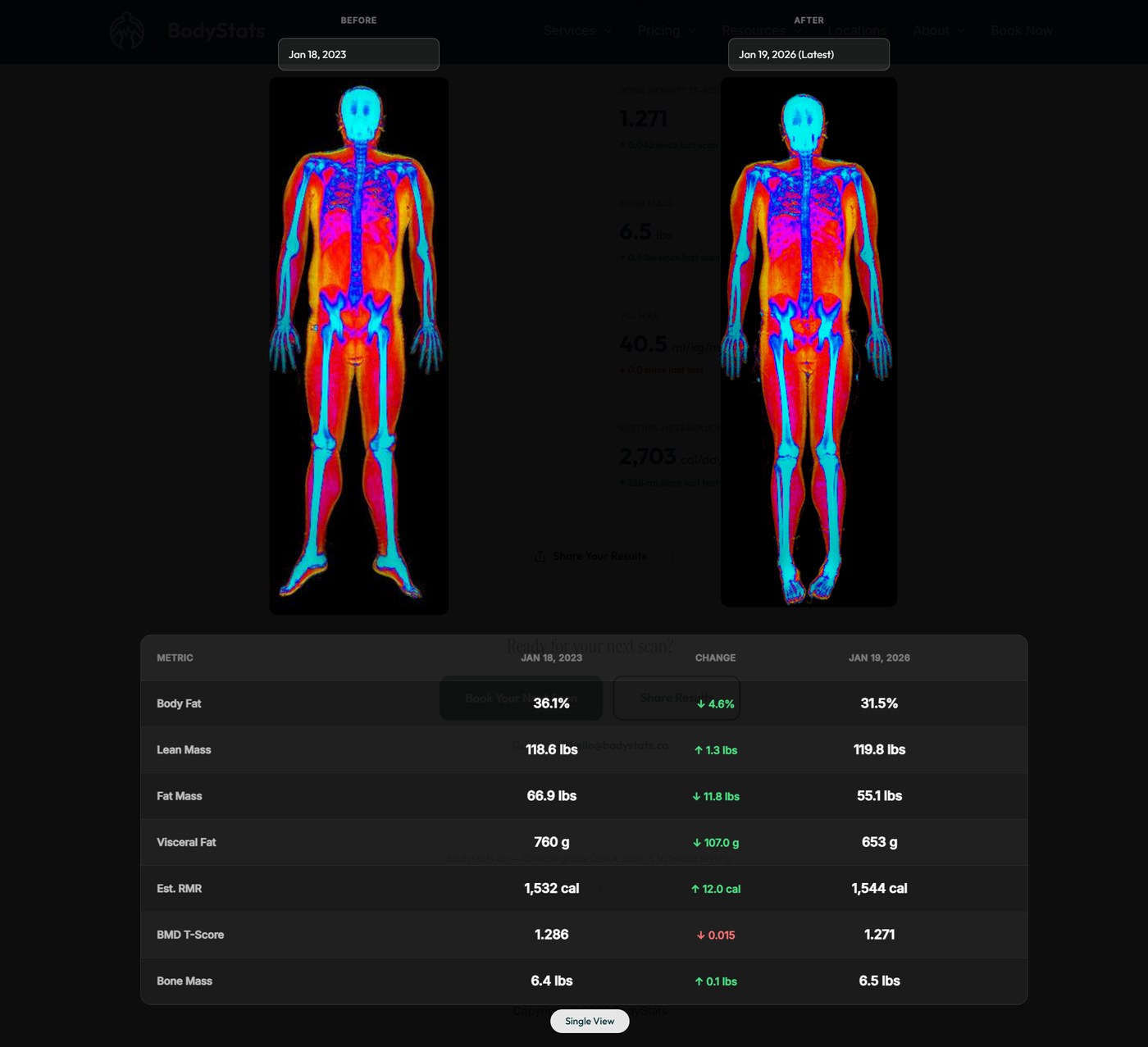
What to look for in each scan
Lean mass
The headline number. Did it actually move up? Be careful about water shifts — a 1 lb lean mass increase from week-1 to week-2 is mostly water; a 1 lb increase across 8 weeks is more likely real muscle.
Fat mass (lb)
Should creep up too — that’s the cost of bulking. The question is the ratio. If lean mass gained 4 lb and fat gained 6 lb, your surplus is too aggressive.
Visceral fat (VAT)
Should stay relatively stable during a clean bulk. Big VAT increases suggest the surplus is going to bad places. Reduce calories or switch to lower-glycemic foods.
Regional symmetry
Are both legs gaining? If your dominant side is gaining faster, your training is asymmetric. Add unilateral work.
What to do if the scan is bad
If the muscle-to-fat ratio is below 50/50, options:
- Reduce surplus by 100–150 calories. The most common fix.
- Re-evaluate protein. Below 0.8 g/lb is often too low.
- Audit training. Are you actually progressing in lifts? Or just adding workout volume?
- Sleep audit. Cutting sleep below 7 hours during a bulk meaningfully reduces muscle synthesis.
When to switch to a mini-cut
If you’ve gained 8–15 lb total but the muscle-to-fat ratio drifted to 50/50 or worse, a 4–6 week mini-cut can reset things. Drop calories 300–500 below TDEE for 4 weeks, then return to surplus. Re-scan at the end.
Frequently asked questions
How fast can I gain muscle?
For trained lifters past year one: 0.5–1 lb of true lean mass per month. Beginners can gain 1–2 lb/month for 6–12 months (“newbie gains”). Anything advertised faster is usually water or fat.
Should I do a “dirty bulk”?
Almost never. Excess calories preferentially go to fat once protein needs are met. A lean bulk yields more muscle in less time than a dirty one.
How long should a bulk last?
16–24 weeks for most. Beyond that, the muscle-to-fat ratio of new weight tends to deteriorate.
Is creatine worth it during a bulk?
Yes — 3–5 g/day. Adds about 1–2 lb of intracellular water (which DEXA reads as lean mass) and supports training output. Just be aware the lean mass jump in scan 1 vs scan 2 includes some of that water.
Track your real gains.
Book a DEXA bulk-baseline at BodyStats Vancouver or Toronto. $29.99 per scan, or $20/month for unlimited.
Book a Bulk Baseline