

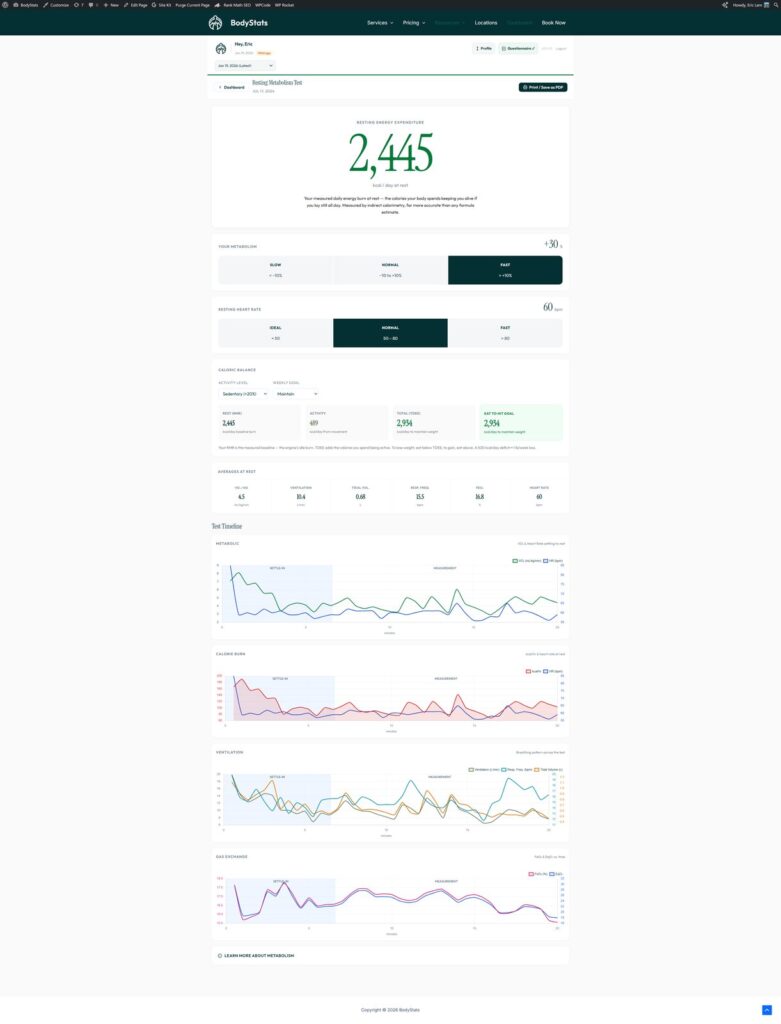
Resting Metabolic Rate: The Number That Drives 60% of Your Calorie Burn.
Get your RMR wrong and every diet plan you build on top is wrong by 100–300 calories a day. Here’s what it measures, what ours says about it, and how to actually test yours.
Book an RMR TestIf you’ve ever wondered why two people of the same height and weight can lose fat at completely different rates on the same diet, the answer is usually their resting metabolic rate. RMR is the calories your body burns just keeping you alive — heart beating, brain running, organs working — when you’re doing absolutely nothing. It accounts for 60–70% of your daily energy expenditure, and it varies more between individuals than most people realize. An RMR test measures yours directly so you can stop guessing and start working with real numbers.
- Your RMR is the calories you burn at complete rest — typically 1,200–1,800 for adults.
- RMR is 60–70% of your total daily calorie burn, so getting it right matters more than counting steps.
- BodyStats clients average 1,261–1,730 RMR depending on age and sex (n=9,826 scans).
- You don’t need a metabolic cart to estimate RMR — a DEXA scan derives it directly from your lean mass.
What is RMR, exactly?
Resting Metabolic Rate is the energy your body uses to maintain itself while at rest. It includes your heart pumping, lungs breathing, kidneys filtering, brain firing, and your cells doing the constant background work of being alive. It does not include exercise, walking around, fidgeting, or even digesting food. Those add on top.
RMR is closely related to two other terms you’ll see on metabolic reports:
- BMR (Basal Metabolic Rate) — measured under stricter laboratory conditions: overnight fast, fully reclined, in a thermoneutral room. About 5–10% lower than RMR. In practice, RMR and BMR are used interchangeably outside research labs.
- TDEE (Total Daily Energy Expenditure) — your full daily calorie burn, including activity. RMR plus the calories from movement, exercise, and digestion.
For a longer breakdown of which number to use when, see our RMR vs TDEE comparison.
Why your RMR matters more than your step count
Here’s the scale of the thing: if your RMR is 1,500 calories, that’s 1,500 calories burned today before you’ve taken a step. A 60-minute moderate workout burns maybe 400 calories. Walking 10,000 steps burns roughly 300–500. Even an aggressive day of activity adds maybe 800–1,000 calories on top of RMR.
A 100-calorie error in your RMR estimate is a 100-calorie error in your daily target every day. Across a 12-week cut, that’s enough to swing a 10-pound result into a 6-pound result, or vice versa.
What our data shows about typical RMR by age and sex
From 9,826 BodyStats DEXA scans, here’s what an average person’s RMR looks like:
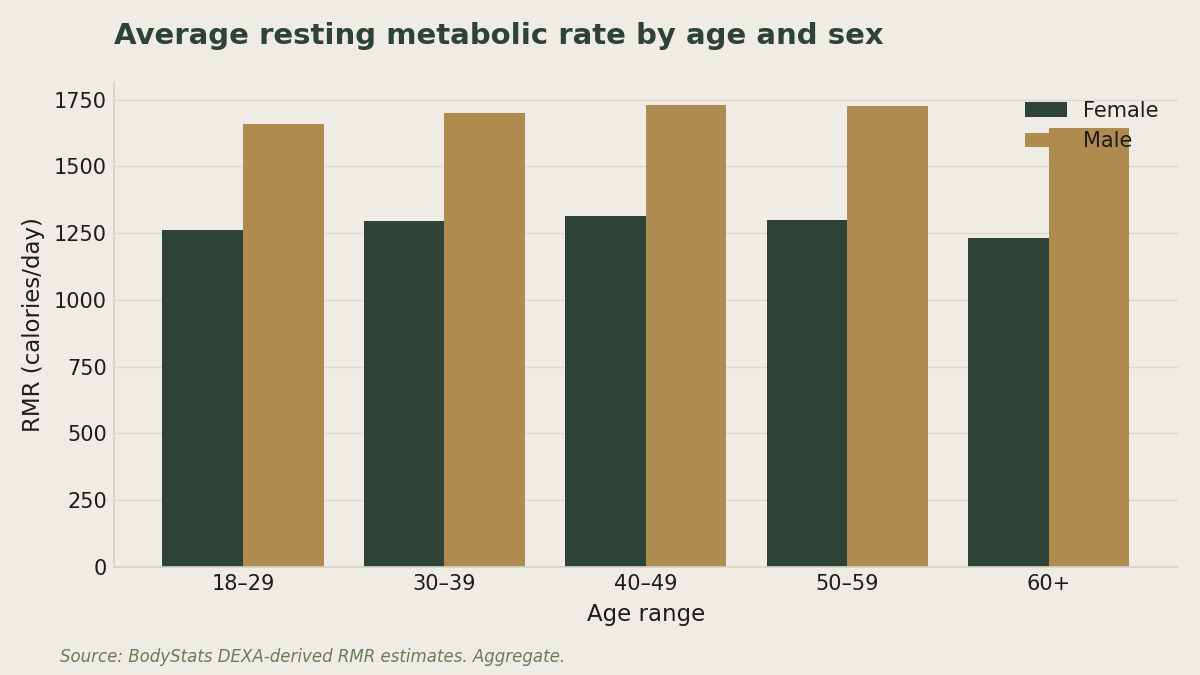
Three things to notice. First, the male-female gap is roughly 400 calories per day across every age group — that’s a difference driven mostly by lean mass, not biology mystery. Second, RMR doesn’t crater with age the way most people fear; the drop from peak (40s for both sexes) to 60+ is only about 80–100 calories. Third, the within-group spread is large. Two 35-year-old men can easily differ by 300 calories in RMR. Averages set the centre of gravity, not your individual number.
How an RMR test works
There are two ways to find out your RMR — one direct, one derived.
Direct: indirect calorimetry (metabolic cart)
You lie down for 15–20 minutes wearing a mask or canopy. The machine measures the oxygen you consume and the carbon dioxide you exhale, then calculates your RMR from the gas exchange. This is the lab gold standard and the method most “RMR test” services advertise.
Derived: lean-mass-based estimation from DEXA
RMR is overwhelmingly determined by how much lean tissue you have — muscles, organs, and brain are the main metabolic engines. A DEXA scan measures your lean mass directly, then uses validated equations (Cunningham, Mifflin-St Jeor) to derive RMR. The math works because the relationship between lean mass and RMR is one of the strongest in metabolic physiology.
At BodyStats, you get the DEXA-derived RMR included with every scan. If you want a direct metabolic cart measurement on top of that, our RMR test covers it.
How to prepare for an RMR test
For the most accurate reading:
- Fast for 4–8 hours before the test. Digestion raises your metabolic rate by 10–15%.
- Avoid caffeine for 4 hours. Caffeine elevates RMR temporarily and inflates the result.
- Skip exercise that morning. Anything intense in the past 4 hours will artificially raise your reading.
- Sleep normally the night before. Sleep deprivation can suppress RMR by 5–8%.
- Bring something to read. The test itself is 15–20 minutes of lying still.
What you do with your RMR number
Once you have a real RMR, the rest of your nutrition math gets simpler:
- For maintenance: RMR × an activity multiplier (1.2 sedentary, 1.4 lightly active, 1.6 active, 1.8 very active) gives you your TDEE — your maintenance calories.
- For fat loss: Eat 300–500 calories below TDEE for a ~1 lb/week loss. Below RMR is too aggressive for most people.
- For muscle gain: Eat 200–400 calories above TDEE with adequate protein (around 0.7–1 g per pound of bodyweight).
- For tracking over time: Re-test every 8–12 weeks during a cut or bulk. RMR shifts as your body composition shifts — and your BodyStats dashboard plots that drift automatically.
If you’d rather skip the spreadsheet, our TDEE calculator takes your RMR (or estimates one from your stats) and produces a daily target.
Frequently asked questions
How long does an RMR test take?
The DEXA-derived version takes the seven minutes of the scan itself. The metabolic-cart direct measurement takes 15–20 minutes plus setup, for a total appointment of about 30 minutes.
Do I need to fast before an RMR test?
For metabolic-cart testing, yes — 4 to 8 hours. For DEXA-derived RMR, fasting matters less because the calculation is from your lean mass, not your current metabolic state. Same-day food won’t change a DEXA-derived RMR meaningfully.
How accurate is a DEXA-derived RMR vs a metabolic cart?
Both are within ~5% of each other for most people. Metabolic carts capture short-term metabolic state (helpful if you suspect thyroid issues or want to detect adaptive thermogenesis). DEXA-derived RMR captures your structural metabolic capacity — what your body composition predicts. We recommend both if you can: DEXA quarterly, cart annually.
Why is my RMR lower than online calculators predicted?
Online calculators use population averages based on age, sex, height, and weight. They don’t see your actual lean mass. If you have less muscle than the average person of your stats, your real RMR will be lower than the calculator’s guess. The reverse is also true — well-trained athletes often have higher RMRs than calculators predict.
Does RMR really drop after 40?
Slightly, and mostly because of lean-mass loss, not metabolic damage. Our data shows the average male RMR drops from 1,730 (40s) to 1,646 (60+) — a 5% decline across two decades. Maintaining muscle through resistance training is the single biggest lever you have on RMR over time.
Get your real RMR.
Book an RMR test at BodyStats Vancouver or Toronto. Direct metabolic-cart measurement plus DEXA-derived comparison.
Book an RMR Test