

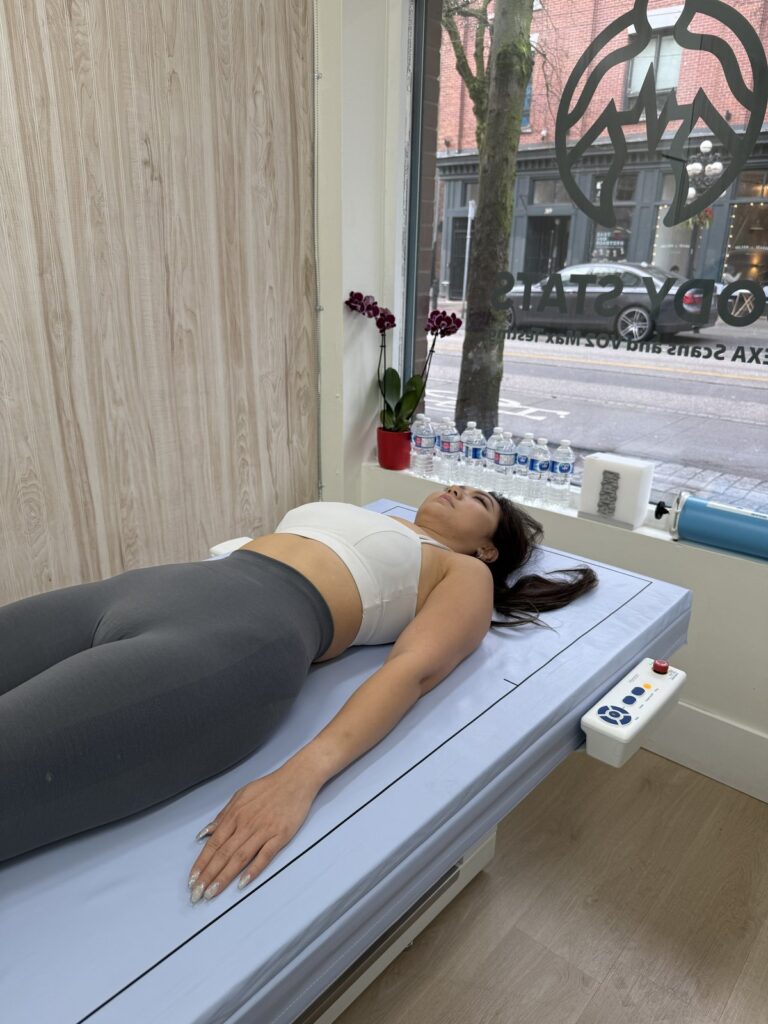
The Year-End Body Composition Review.
The mirror lies. The scale forgets. A January DEXA paired with a December DEXA tells you exactly what the year actually changed. Here’s how to set up the review.
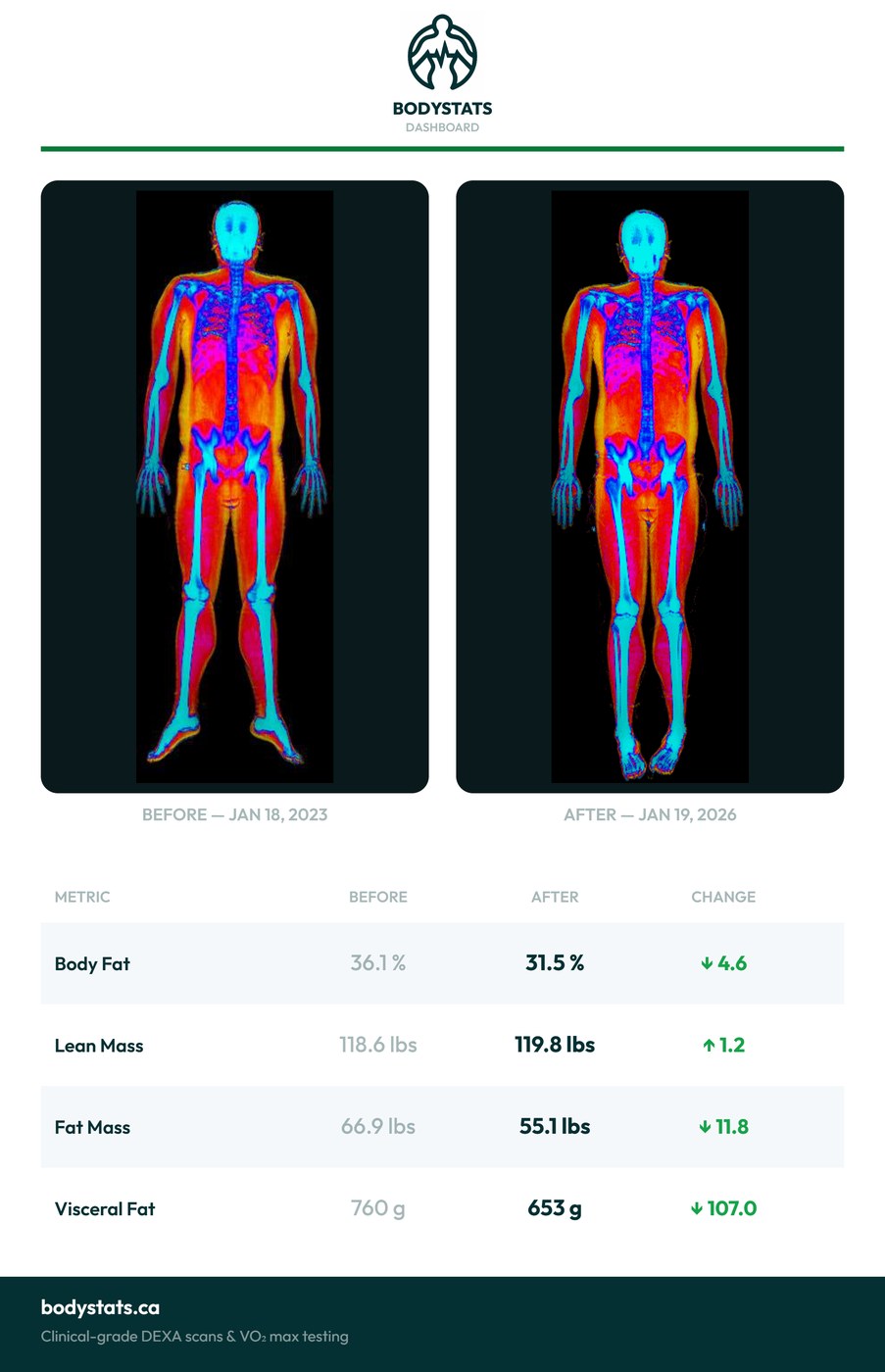
Book Year-End ScanMost year-end reviews are vibes. “I think I lost weight this year.” “I feel stronger.” “My pants fit better.” Vibes are useful but unreliable. A January DEXA paired with a December DEXA replaces vibes with data — exactly how much fat you lost or gained, how much muscle you built, where on your body things changed, and whether your bones held up. Here’s how to do a real year-end body composition review.
- Pair a January DEXA with a December DEXA for a clean year-over-year comparison.
- Compare lean mass, fat mass, visceral fat, regional breakdown, and bone mass.
- Most realistic year-over-year change: ±5–10 lb of fat or muscle for active adults.
- The data is more useful than the resolution. Use it to plan next year.
Why the year-over-year comparison matters
Eight-week scans show training-block changes. Quarterly scans show seasonal patterns. Year-over-year scans show life patterns — the slow drift that quarterly scans can hide because each one is close to the last. A year of stable weight can hide:
- Lean mass quietly dropping (2–3 lb), with fat replacing it.
- Visceral fat creeping up while subcutaneous holds steady.
- Bone mass declining if you stopped resistance training.
- Regional asymmetries developing from a chronic injury or training imbalance.
A year-over-year DEXA review surfaces all of it.
How to set up the review
Step 1 — find or schedule your January baseline
If you scanned in January, pull up that report. If you didn’t, January-of-next-year becomes your new baseline — and you’ll do this review for the first time in 12 months.
Step 2 — book a December scan
Same studio, ideally same time of day, similar conditions. Wear similar clothes. Hydrate normally.
Step 3 — open both reports side by side
Or pull up your BodyStats dashboard, which graphs every metric over time automatically. Compare:
- Total weight — directional only.
- Total body fat % — the headline change.
- Lean mass — the most important number for longevity.
- Fat mass (lb) — the absolute fat change.
- Visceral fat — direction matters more than absolute number.
- Bone mass — should hold steady or improve with resistance training.
- Regional symmetry — left vs right limbs.
Realistic year-over-year ranges
| Metric | Modest annual change | Aggressive annual change |
|---|---|---|
| Body fat % | ±2–4% | ±6–10% |
| Lean mass | ±1–3 lb | ±5–10 lb |
| Fat mass | ±5–10 lb | ±15–30 lb |
| Visceral fat | ±100–300 g | ±500–1,000 g |
| Bone mass | ±0.1 | ±0.3 |
If your year-over-year change is bigger than the “aggressive” column, we’d recommend pausing to confirm — usually it’s a measurement artifact (different scanner, very different hydration, scan position issues).
Common year-over-year patterns
The “stable but worse” pattern
Same weight, but lean mass dropped 2–3 lb and fat mass climbed by the same. Common in busy professionals who stopped training consistently. The fix: resistance training, 3 sessions/week, for the next year.
The “successful cut” pattern
Weight down 8 lb, lean mass down 1 lb, fat mass down 7 lb. Visceral fat down 200 g. Excellent — a high-quality cut with minimal muscle loss.
The “sneaky bulk” pattern
Weight up 6 lb, lean mass up 2 lb, fat mass up 4 lb. Mediocre muscle/fat ratio. Could’ve been leaner with a smaller surplus.
The “training plateau”
Lean mass flat, fat mass flat, weight flat. Often a sign you’ve stopped progressing in training. Add a new stimulus — different exercises, intensity, frequency.
Most year-end reviews surface one or two surprises. The data is rarely what people expected — and that’s why it’s useful.
What to do with the review
- Pick one metric to improve. Don’t try to fix everything. Visceral fat down 100 g, or lean mass up 2 lb — concrete and tractable.
- Set a 12-week intervention. Specific training and nutrition changes aimed at that metric.
- Re-scan at week 12. Confirm the intervention is working before committing to a full year.
- Repeat. A year of four 12-week interventions, each guided by data, is the most reliable route to actual physical change.
Frequently asked questions
What if I don’t have a January baseline?
Schedule a December scan now and set it as your baseline. The review starts in 12 months. Or use any prior scan you have as a comparison point.
Can I compare scans from different clinics?
With caveats. Different scanners report visceral fat slightly differently, and segmental lean mass varies between Hologic and GE Lunar models. Same-clinic comparison is cleaner. BodyStats compares against the same scanner across visits.
How long should I wait between scans?
For year-end reviews, 11–13 months is the right window. For training-block tracking, 8–12 weeks.
Is the year-end review worth doing every year?
Yes. Cumulative drift over multiple years is the slowest, sneakiest pattern — and the one most worth catching early.
Set up the review.
Book a year-end DEXA at BodyStats Vancouver or Toronto. $29.99 single scan, or $20/month subscription. Pair with a January follow-up.
Book Year-End Scan