
The Definitive Guide
What is a DEXA Scan?
Everything you need to know about dual-energy X-ray absorptiometry — the gold standard for measuring body fat, lean muscle, and bone density.
🏥 10,000+ Scans Completed
📍 Vancouver & Toronto
In This Guide
2. How DEXA Technology Works
3. The Dual-Energy X-ray Principle
4. What a DEXA Scan Measures
5. DEXA vs. Other Methods
6. Who Benefits from DEXA?
7. What to Expect at Your Scan
8. Reading Your DEXA Results
9. Safety & Radiation
10. Frequently Asked Questions
11. Book Your Scan at BodyStats
Chapter 1
What is a DEXA Scan?
A DEXA scan — short for Dual-Energy X-ray Absorptiometry (also written as DXA) — is a medical imaging technology that uses two X-ray beams at different energy levels to precisely measure the composition of your body. In a single 3-to-6-minute scan, DEXA separates your body into three distinct tissue types: bone mineral, lean soft tissue (muscle, organs, water), and fat tissue.
Originally developed in the 1980s for diagnosing osteoporosis by measuring bone mineral density (BMD), DEXA has since become the clinical gold standard for body composition analysis. It is the reference method used in peer-reviewed research, hospital endocrinology departments, professional sports organizations, and military fitness standards worldwide.
Unlike a bathroom scale that gives you a single weight number, or BMI that uses only height and weight, a DEXA scan provides a region-by-region map of exactly where fat and muscle are distributed across your body — your arms, legs, trunk, and the critical android (abdominal) and gynoid (hip) regions.
Why “Gold Standard”?
In body composition science, a method is called the gold standard when it is the most accurate, reproducible, and widely validated technique available. DEXA earned this status because of its exceptional precision (1–2% error margin), its ability to differentiate three tissue types simultaneously, and decades of peer-reviewed validation across diverse populations.
Chapter 2
How DEXA Technology Works
Understanding how a DEXA scanner works helps you appreciate why it is so much more accurate than other body composition methods. The technology is elegant in concept but highly sophisticated in execution.
The Core Components of a DEXA Scanner
A DEXA scanner consists of three primary components working together: an X-ray source mounted beneath the scanning table, a detector array positioned on a movable arm above the patient, and advanced software that processes the raw attenuation data into a body composition report.
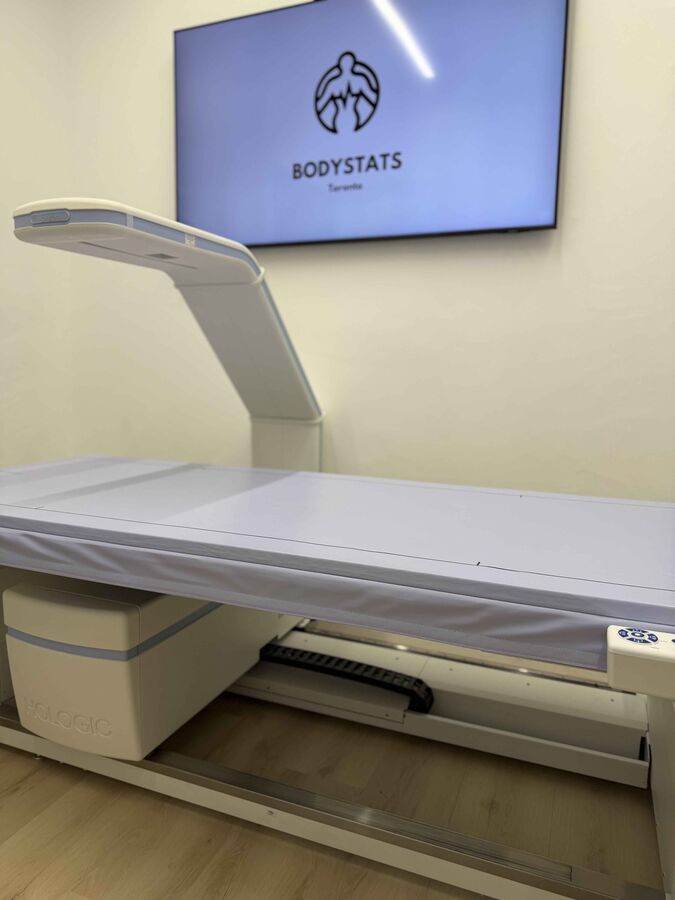
The Hologic Horizon W DEXA scanner at BodyStats Vancouver — one of the most advanced whole-body composition scanners available.
The X-ray source generates photons at two distinct energy levels — typically around 40 keV (kiloelectron volts) and 70–100 keV. These two energy levels are the “dual energy” in DEXA’s name, and they are the key to the entire technology. As the scanning arm slowly traverses the length of your body (from head to toe), the detector above you measures how many photons from each energy level pass through your tissues at every point.
Pencil Beam vs. Fan Beam Scanners
DEXA scanners come in two main geometries, and understanding the difference matters for accuracy:
Pencil beam scanners use a highly focused, narrow beam of X-rays that scans the body in a raster pattern (back and forth, line by line). These produce extremely accurate measurements with very low radiation but scan more slowly (6–10 minutes).
Fan beam scanners — like the Hologic Horizon W and GE Lunar Prodigy used at BodyStats — project a wider, fan-shaped beam. A linear array of detectors captures the entire width of the body in a single pass, which dramatically speeds up scan times (3–6 minutes) while maintaining clinical-grade accuracy. Fan beam scanners are now the industry standard in both clinical and research settings.
BodyStats Equipment
BodyStats operates both a Hologic Horizon W (Vancouver — Gastown) and a GE Lunar Prodigy (Vancouver — Yaletown). Both are hospital-grade fan beam scanners used in clinical research worldwide. BodyStats is the only company in North America with access to both of these units.
Chapter 3
The Dual-Energy X-ray Principle
This is the physics that makes DEXA uniquely powerful. Here is how the dual-energy principle works in plain language:
Different tissues in your body absorb X-rays at different rates depending on the energy level of the photon. Bone, which is dense and contains high-atomic-number elements like calcium and phosphorus, absorbs X-rays very differently than soft tissue (fat and muscle). Crucially, fat and lean tissue also absorb X-rays at slightly different rates from each other.
By sending X-rays at two energy levels simultaneously, the DEXA scanner creates a system of equations that can be solved mathematically to determine the exact composition of tissue at each pixel point along your body:
The Three-Step Separation Process
Step 1 — Bone vs. Soft Tissue: The ratio of low-energy to high-energy X-ray attenuation (called the R-value) at each pixel is compared to known reference values. When the R-value exceeds a threshold, the pixel is classified as containing bone mineral. This is how DEXA measures bone mineral density (BMD) and bone mineral content (BMC).
Step 2 — Fat vs. Lean Tissue: In pixels that do NOT contain bone, the R-value between the two energy levels varies based on fat-to-lean ratio. Pure fat has a known R-value; pure lean tissue has a different known R-value. The software interpolates between these to calculate the exact fat and lean percentage at each pixel.
Step 3 — Bone-Adjacent Estimation: For pixels that DO contain bone, the software cannot directly measure the soft-tissue composition behind the bone. Instead, it uses sophisticated algorithms to estimate fat and lean proportions in bone-containing pixels by interpolating from neighboring soft-tissue pixels. This is the most computationally complex step and where proprietary manufacturer algorithms (Hologic vs. GE) differ most.
The result is a pixel-by-pixel composition map of your entire body — thousands of data points that are then aggregated into the regional and whole-body measurements you see on your DEXA report.
Why Two Energy Levels Matter
A single-energy X-ray (like a standard medical X-ray) can only distinguish between “dense” and “less dense” tissue. It sees bone clearly but cannot differentiate fat from muscle — they look nearly identical at a single energy. By using two energy levels, DEXA exploits the fact that the ratio of absorption between the two energies differs for each tissue type. This mathematical relationship is what allows DEXA to separate your body into exactly three compartments with precision no other non-invasive method can match.
Chapter 4
What a DEXA Scan Measures
Your DEXA report is packed with data. Here is what each metric means and why it matters:
📊
Total Body Fat Percentage
Your total fat mass divided by your total body mass. This is the single most popular metric — it tells you what proportion of your body weight is fat tissue. DEXA measures this with 1–2% accuracy, far surpassing scales and calipers.
💪
Lean Muscle Mass
The total weight of everything that is not fat or bone — primarily skeletal muscle, but also organs and water. DEXA breaks this down by region so you can see if your left arm carries less muscle than your right, or if your legs are disproportionately strong.
🦴
Bone Mineral Density (BMD)
Measured in grams per square centimetre (g/cm²), BMD indicates the density and strength of your bones. Low BMD can signal osteopenia (early bone loss) or osteoporosis (significant bone loss). This data is particularly valuable for women over 40 and anyone with osteoporosis risk factors.
🎯
Visceral Adipose Tissue (VAT)
Visceral fat is the fat stored deep inside your abdominal cavity, surrounding your liver, intestines, and other organs. It is metabolically active and strongly linked to insulin resistance, cardiovascular disease, and type 2 diabetes. DEXA quantifies VAT area and volume — data you cannot get from a scale or mirror.
⚖️
Android / Gynoid Ratio (A/G Ratio)
The android region is your midsection (belly area); the gynoid region is your hips and thighs. The A/G ratio compares fat distribution between these two zones. A higher ratio (more abdominal fat) is associated with greater metabolic risk, regardless of your total body fat percentage.
🔄
Regional Composition Breakdown
DEXA divides your body into anatomical regions — left arm, right arm, left leg, right leg, trunk, and head — and reports fat mass, lean mass, and bone mass for each. This reveals asymmetries, imbalances, and regional trends that whole-body numbers miss.
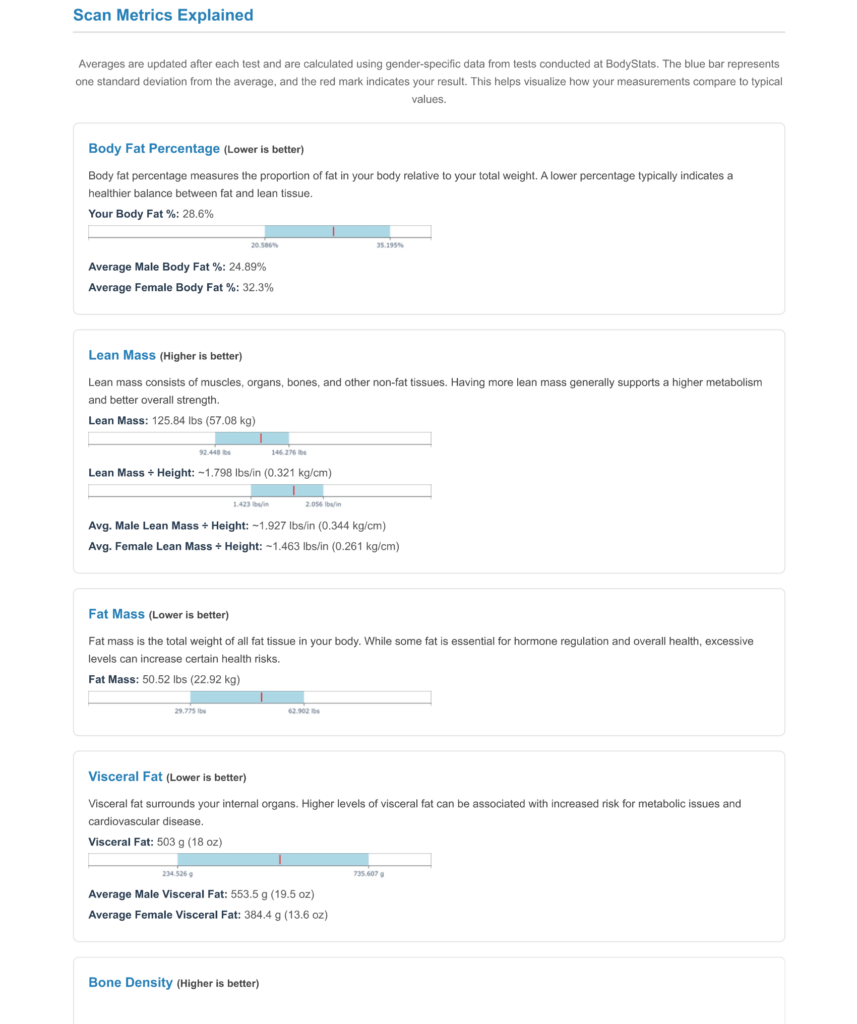
A sample BodyStats DEXA report showing regional body composition data. View full sample report →
Chapter 5
DEXA vs. Other Body Composition Methods
There are many ways to estimate body composition, but they differ dramatically in accuracy, reliability, and the detail they provide. Here is how DEXA compares:
| Method | Accuracy | Regional Data | Bone Density | Visceral Fat | Typical Cost |
|---|---|---|---|---|---|
| DEXA Scan | ±1–2% | ✔ Yes | ✔ Yes | ✔ Yes | $25–$100 |
| BIA (Smart Scales) | ±3–5% | ✘ Estimated | ✘ No | ✘ Estimated | $30–$300 |
| Skinfold Calipers | ±3–6% | ✘ No | ✘ No | ✘ No | $0–$40 |
| Hydrostatic Weighing | ±1.5–2.5% | ✘ No | ✘ No | ✘ No | $40–$150 |
| Bod Pod (ADP) | ±2–3% | ✘ No | ✘ No | ✘ No | $45–$150 |
| BMI (Height + Weight) | N/A | ✘ No | ✘ No | ✘ No | Free |
| MRI / CT Scan | ±1% | ✔ Yes | CT Only | ✔ Yes | $500–$3,000+ |
DEXA occupies a unique sweet spot: it provides near-MRI accuracy at a fraction of the cost, with minimal radiation, in a fast, comfortable scan. No other consumer-accessible technology matches this combination of precision, detail, and affordability.
The BIA Problem
Smart scales and handheld BIA devices are popular because they are convenient, but their readings can swing 3–5% based on hydration, meal timing, exercise, and even skin temperature. A person who is 25% body fat could read anywhere from 20% to 30% on a BIA device depending on conditions. DEXA eliminates this variability — your reading reflects your actual tissue composition, not how much water you drank that morning.
Chapter 6
Who Benefits from a DEXA Scan?
DEXA scans are not just for bodybuilders or elite athletes. The data is valuable for anyone who wants to understand their body at a deeper level than a scale provides.
🏃 Athletes & Fitness Enthusiasts
Track muscle gain vs. fat loss across training cycles. Identify muscle imbalances between limbs. Monitor body composition through bulking and cutting phases. Get objective data to assess whether your programming is working.
🍎 Weight Loss & Diet Tracking
The scale cannot tell you if you are losing fat or muscle. DEXA can. Ensure your calorie deficit is targeting fat tissue, not cannibalizing hard-earned muscle. Track visceral fat reduction for metabolic health improvements.
🩹 Proactive Health Monitoring
Detect early signs of osteoporosis through bone density measurements. Monitor visceral fat — a major independent risk factor for cardiovascular disease and type 2 diabetes. Establish baselines for aging, menopause, or medical treatment.
👩⚕️ Medical & Clinical Use
Physicians use DEXA to assess sarcopenia (age-related muscle loss), monitor patients on corticosteroids or hormone therapy, evaluate eating disorder recovery, and guide post-surgical rehabilitation programs.
🧓 Aging & Longevity
After age 30, adults lose approximately 3–8% of muscle mass per decade without resistance training. DEXA provides the data to catch and reverse this trend early, supporting functional independence and metabolic health as you age.
🤔 The Simply Curious
Sometimes you just want to know where you stand. DEXA gives you a complete snapshot of your body — no guessing. At $25 at BodyStats, it is an affordable baseline that can inform better decisions going forward.
Chapter 7
What to Expect at Your DEXA Scan
Getting a DEXA scan at BodyStats is a quick, painless experience. Here is the full walkthrough:
Preparation (Day Before & Day Of)
Hydrate normally but avoid drinking excessive fluids immediately before your appointment. Fast for 2–3 hours before the scan for the most consistent results. Wear light, form-fitting clothing with minimal metal — ideally the same outfit every time you scan (your “DEXA outfit”). Remove jewelry, belts, and watches.
Arrival & Check-In
Arrive at your scheduled appointment time at one of our locations. You will fill out a short consent form and briefly discuss your goals with our technician. The whole check-in process takes about 2 minutes.
The Scan (3–6 Minutes)
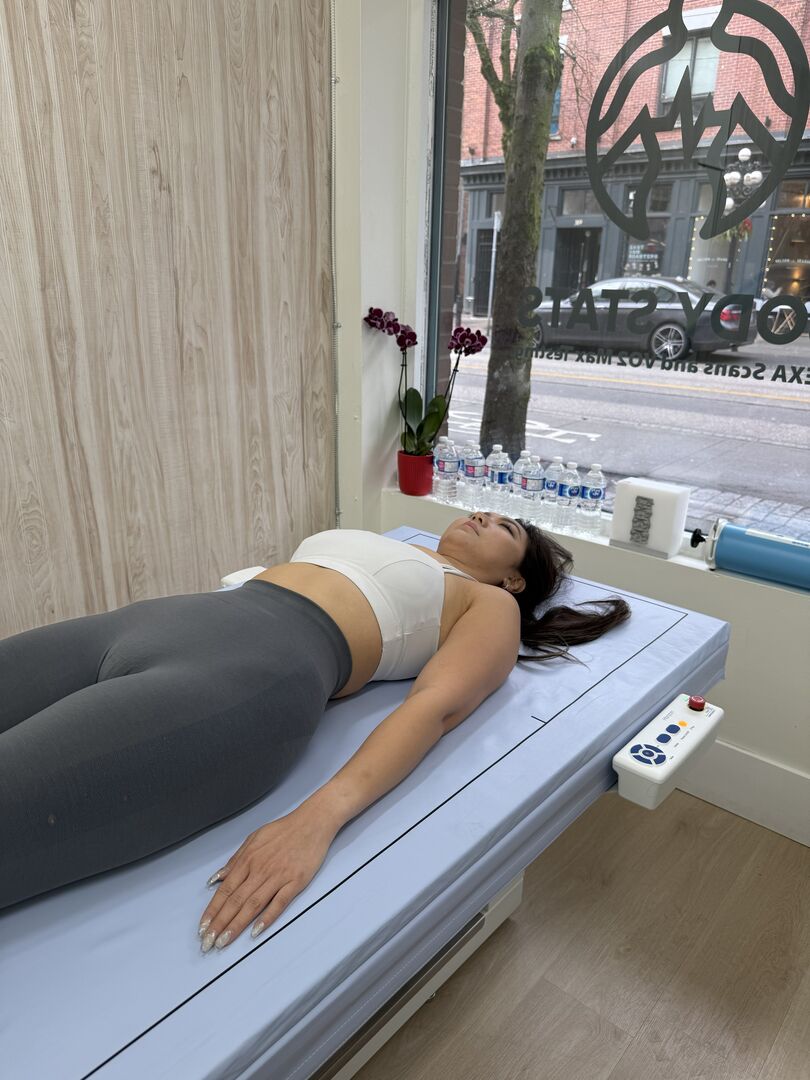
You will lie flat on the padded scanning table with your arms at your sides and feet together. The scanning arm will pass slowly over your body from head to toe. You will not feel anything — no vibration, no heat, no discomfort. Just lie still and breathe normally. The entire scan takes 3–6 minutes.
Results & Report
Your comprehensive report is emailed to you the same day. It includes your total body fat percentage, lean mass, bone density, regional breakdowns, visceral fat analysis, and comparison to your previous scans if applicable. If you would like a detailed walkthrough, you can schedule a Zoom consultation with our team.
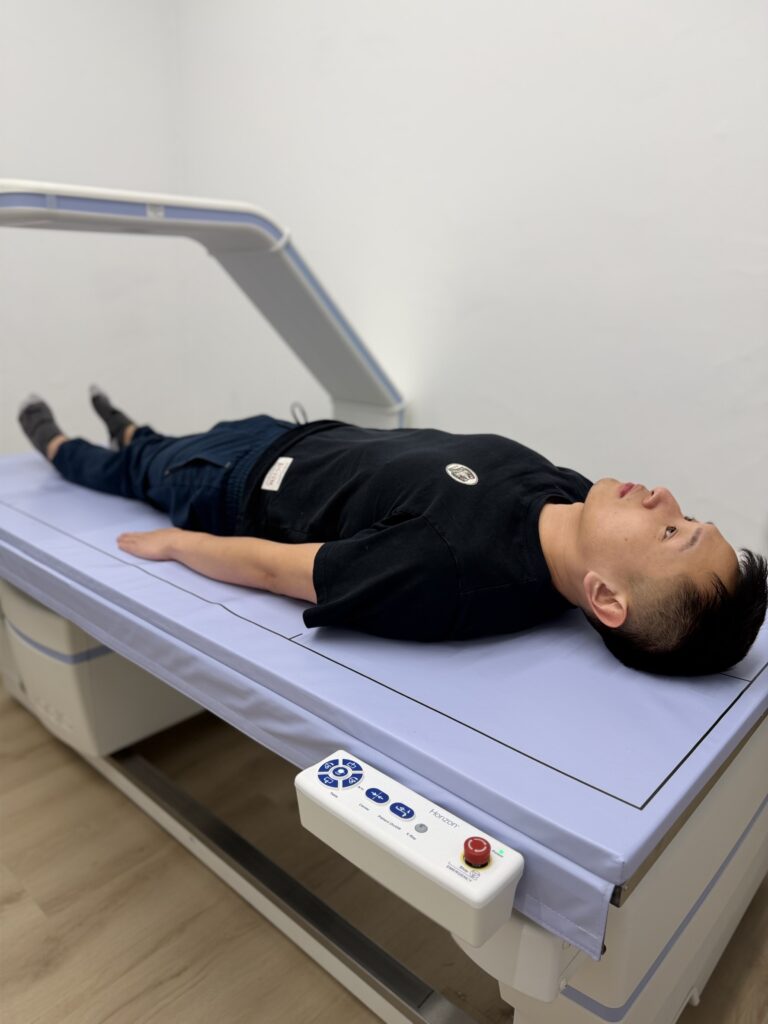
A DEXA scan in progress at BodyStats. The scanning arm passes over you while you lie still — completely painless.
Chapter 8
How to Read Your DEXA Scan Results
Your DEXA report contains a lot of data. Here is a primer on what to look for:
Body Fat Percentage Ranges
These general reference ranges are based on DEXA-measured body fat percentages. Keep in mind that ideal ranges vary by age, sex, activity level, and individual health goals — there is no single “perfect” number.
| Category | Men | Women |
|---|---|---|
| Essential Fat | 2–5% | 10–13% |
| Athletic | 6–13% | 14–20% |
| Fitness | 14–17% | 21–24% |
| Average | 18–24% | 25–31% |
| Above Average | 25%+ | 32%+ |
From Our Data
Across 10,000+ DEXA scans at BodyStats, the average body fat percentage for male clients is 24.39% and for female clients is 33.40%. These averages reflect the general population who walk through our doors — from first-time scanners to competitive athletes.
What to Focus On
Trends over time matter more than any single number. Your first DEXA scan establishes a baseline. Subsequent scans (every 8–12 weeks) reveal whether your training, nutrition, and lifestyle changes are producing the results you want. Focus on the direction and rate of change in your body fat, lean mass, and visceral fat — not on hitting a specific percentage after one scan.
Regional asymmetries are worth paying attention to. If your right leg has significantly more muscle than your left, that imbalance can lead to injury over time. DEXA gives your physiotherapist or trainer the data to prescribe corrective work.
Visceral fat deserves special attention. Even people with a “healthy” total body fat percentage can carry dangerous levels of visceral fat. Your DEXA report quantifies this directly, giving you and your doctor actionable data.
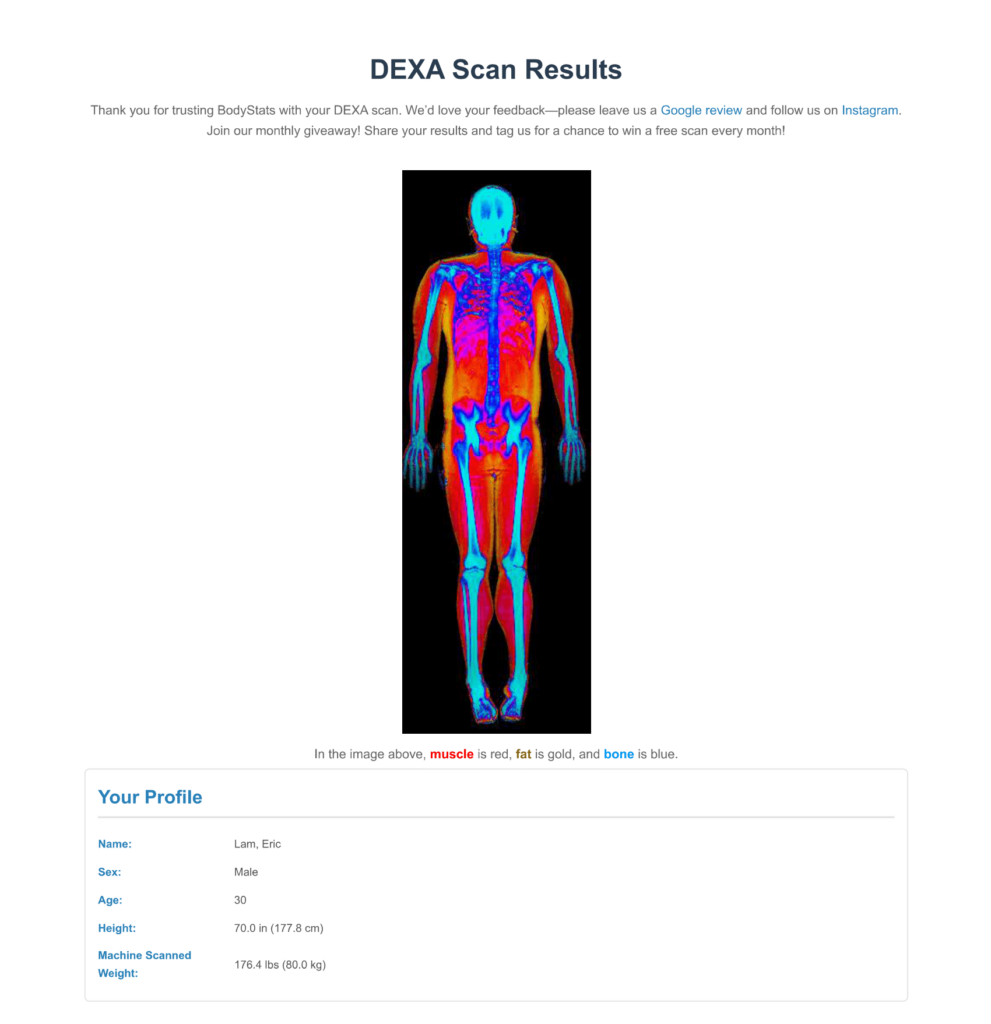
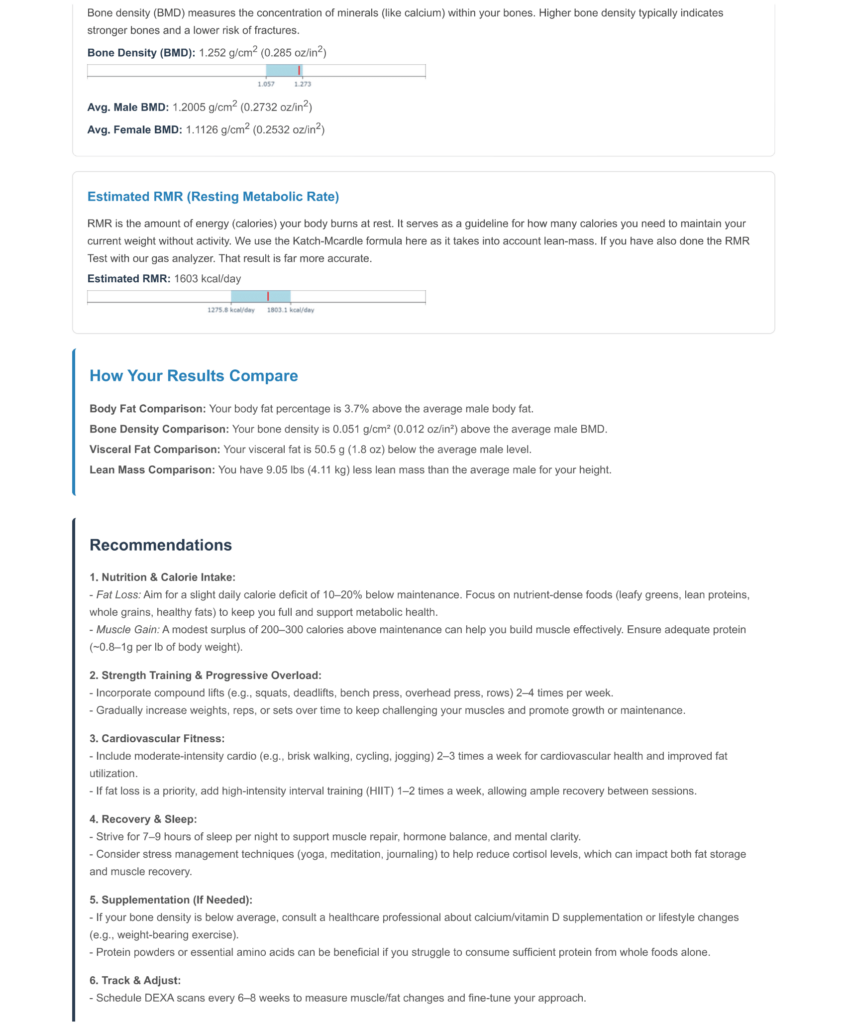
Pages from a sample BodyStats DEXA report. View the complete sample report →
Chapter 9
Safety & Radiation Exposure
One of the most common questions about DEXA scans is about radiation safety. Here is the full picture:
A whole-body DEXA scan delivers approximately 0.4 to 5 microsieverts (μSv) of effective radiation dose, depending on the specific machine and scan mode. To put this in perspective:
Radiation Dose Comparisons
~1–5 μSv
DEXA Scan
~7 μSv
Daily background
~40 μSv
Cross-country flight
~100 μSv
Chest X-ray
~7,000 μSv
CT Scan (abdomen)
~10 μSv
100 bananas
A DEXA scan exposes you to roughly the equivalent of 1–2 hours of natural background radiation — the kind you receive just from being alive on Earth. You could get a DEXA scan every single week for a year and still receive less total radiation than a single abdominal CT scan.
Who should avoid DEXA scans? Pregnant women should not undergo any X-ray procedure, including DEXA. If you are pregnant or think you might be, please inform your technician. For everyone else, the radiation exposure from a DEXA scan is considered negligible by all major radiological safety organizations.
Chapter 10
Frequently Asked Questions
What does DEXA stand for?
DEXA stands for Dual-Energy X-ray Absorptiometry. It is also commonly written as DXA. The name describes the technology’s core mechanism: using X-rays at two energy levels (dual-energy) to measure how different body tissues absorb radiation (absorptiometry).
How accurate is a DEXA scan for body fat?
DEXA has a precision error of approximately 1–2% for total body fat percentage. This makes it significantly more accurate than BIA/smart scales (±3–5%), skinfold calipers (±3–6%), or BMI (which does not measure body fat at all). Only MRI approaches similar accuracy, but at 10–30x the cost.
How much radiation does a DEXA scan produce?
A DEXA scan delivers approximately 0.4–5 microsieverts — equivalent to about 1–2 hours of natural background radiation. This is roughly 1/20th of a chest X-ray and 1/1,400th of an abdominal CT scan. It is one of the lowest-radiation imaging procedures available.
How long does a DEXA scan take?
The scan itself takes 3–6 minutes. Your full appointment at BodyStats is typically 10–15 minutes including check-in. If you are doing all three tests (DEXA + VO2 Max + RMR), plan for about 1 hour.
How much does a DEXA scan cost at BodyStats?
DEXA scans at BodyStats start at $25. We also offer a monthly subscription for $20/month, multi-scan packages, and group rates. View our packages →
How often should I get a DEXA scan?
For tracking body composition changes (fat loss, muscle gain), every 8–12 weeks is ideal. This gives your body enough time to show measurable changes. For bone density monitoring, annually is typically sufficient. Our subscription plan is designed to make regular tracking affordable.
Can I wear metal during my scan?
Yes, metal is allowed. However, metal registers as bone on the scanner, so you must wear the same metal items for every scan to keep your results consistent and comparable. If you can remove it, that is ideal. If you have non-removable jewelry or implants, just be consistent.
Do I need to fast before a DEXA scan?
We recommend not eating for 2–3 hours before your scan. Food in your stomach and intestines can add weight to the trunk region, slightly affecting regional body composition results. Water is fine. If you are also doing an RMR test, fasting is especially important for that test’s accuracy.
Is a DEXA scan covered by insurance or OHIP?
DEXA body composition scans used for fitness, longevity, or health tracking are generally not covered by provincial health plans (OHIP, MSP) or private insurance. These plans may cover clinical bone density scans ordered by a physician for specific medical conditions, but private body composition scans are paid out-of-pocket. At BodyStats, our affordable pricing ($25+) makes regular scanning accessible without insurance.
What is the difference between a body composition DEXA and a bone density test?
Both use DEXA technology, but they measure different things. A clinical bone density test (usually ordered by a doctor) focuses on specific skeletal sites — typically the lumbar spine and femoral neck — to diagnose osteoporosis. A body composition DEXA scans your entire body and reports fat mass, lean mass, visceral fat, and regional distribution. BodyStats provides whole-body composition scans. Note: BodyStats scans are intended for body composition analysis only and do not provide clinical bone density diagnoses.
Do I need a doctor’s referral to get a DEXA scan?
No referral is needed. Anyone can book directly at bodystats.ca/scan-me. No prescription or physician order is required for any of our tests.
Get Started
Book Your DEXA Scan at BodyStats
Canada’s largest advanced health tracking service with clinics in Vancouver and Toronto. No referral needed — book online in 30 seconds.
Questions? Email hello@bodystats.ca or DM us on Instagram @body.stats
Disclaimer: BodyStats DEXA scans are intended for body composition analysis only. Our services are not diagnostic and do not assess bone mineral density or fracture risk for clinical purposes. We do not provide medical advice or diagnoses. For medical concerns, please consult a healthcare provider. Information on this page is for educational purposes and is not a substitute for professional medical advice.