

DEXA vs InBody: Which Should You Trust?
InBody scales are everywhere — gym lobbies, locker rooms, even some doctor’s offices. DEXA is the lab gold standard. They produce different numbers for the same person. Here’s why, and which one to actually trust.
Book a DEXAIf you’ve used both an InBody scale at your gym and gotten a DEXA scan, you’ve probably seen them disagree by 3–8 percentage points on body fat. The question everyone asks: which one is right? The short answer is DEXA — but the longer answer is more nuanced. Here’s the honest DEXA vs InBody comparison.
- InBody uses bioelectrical impedance (BIA) — fast, free at most gyms, ±3–5% accuracy.
- DEXA uses dual-energy X-ray — high-precision, ±1.5% accuracy.
- InBody readings drift with hydration, recent meals, and time of day.
- Use InBody for trend; use DEXA for truth.
How each technology works
InBody (BIA)
You stand on the scale, hold the hand grips, and a small electrical current passes through your body via 8 electrodes (feet + hands). The machine measures resistance at multiple frequencies. Lean tissue (water, muscle) conducts well; fat resists. Algorithms estimate body composition from the resistance pattern.
DEXA
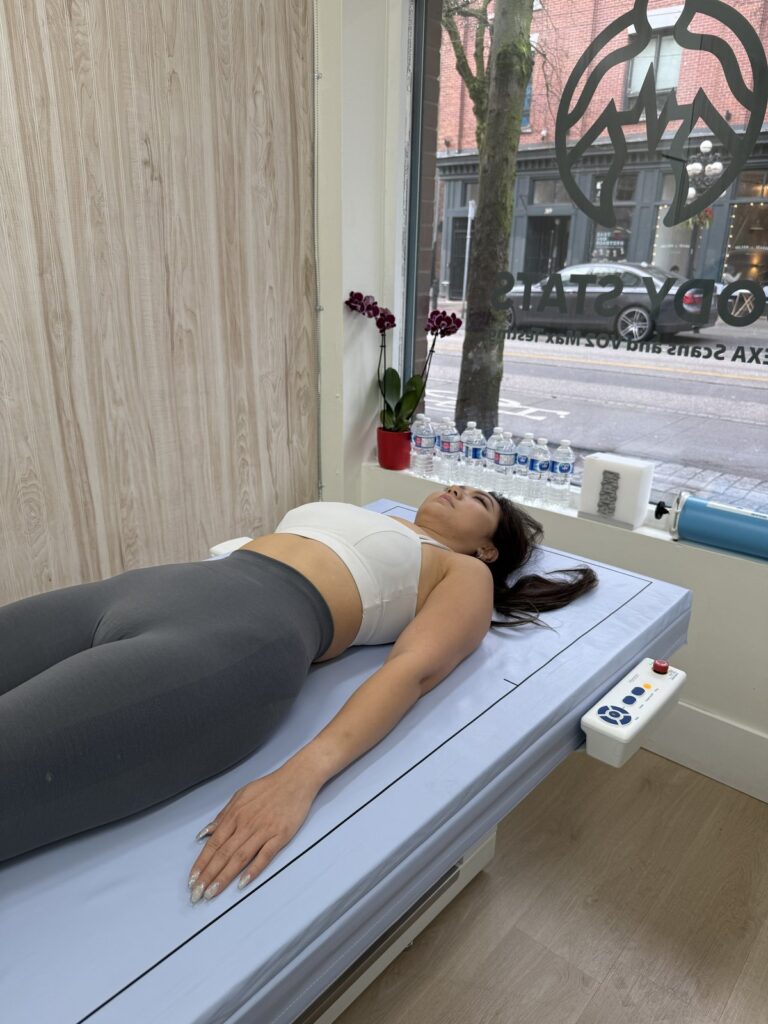
You lie on a padded table while a scanning arm passes over you. Two low-energy X-ray beams measure tissue attenuation. Fat, lean tissue, and bone all attenuate differently — the scanner calculates each from the attenuation pattern. The measurement is direct, not inferred.
Where they differ
| Dimension | InBody | DEXA |
|---|---|---|
| Accuracy (CV) | ±3–5% | ±1.0–1.5% |
| Time | ~60 seconds | 7 minutes |
| Cost | Free at most gyms | $29.99 (BodyStats) – $300+ |
| Regional breakdown | Yes (8 electrodes) | Yes (5 regions, more granular) |
| Visceral fat (VAT) | Estimated | Measured |
| Bone mass | No | Yes (T- and Z-scores) |
| Hydration sensitivity | High | Low |
| Repeatability day-to-day | Moderate | High |
Why InBody readings drift
InBody’s biggest weakness is hydration sensitivity. A 2% body water shift can move the body fat reading by 2–3 percentage points. So:
- Drink a litre of water before stepping on → reading drops.
- Skip water for 8 hours → reading climbs.
- Test post-workout vs pre-workout → different readings.
- Test in the morning vs evening → different readings.
This means an InBody reading from a Monday morning often disagrees with a Wednesday evening reading on the same person, even if no actual body composition change has happened.
If you’re tracking a 12-week cut and your InBody readings vary 4% from hydration alone, you can’t tell if you actually lost fat. The signal disappears in the noise.
Where DEXA wins
Trackable change
Because DEXA’s day-to-day variability is under 1.5%, a real 1–2% body fat change across an 8–12 week training block is visible. With InBody, that change can be lost in measurement noise.
Visceral fat
InBody estimates VAT from segmental impedance. DEXA measures the deep abdominal fat directly. For metabolic-health-oriented clients, DEXA’s VAT number is meaningfully more reliable.
Bone mass
InBody doesn’t measure bone mass at all. DEXA gives you a full bone mass assessment alongside body composition.
Regional precision
Both give regional breakdowns, but DEXA’s are more granular and more accurate. Particularly important if you’re tracking asymmetry.
Where InBody wins
Daily access
If your gym has an InBody and you can step on it any time, that’s hard to beat for trend tracking. Once-a-week InBody readings can show a directional trend even if absolute numbers are wrong.
Cost (often free)
Most major gyms include InBody scans free for members. If you’re testing 3+ times a month, the cost difference adds up.
Speed
60 seconds vs 7 minutes plus appointment booking. Convenient if you want a quick check.
The right combination
- Daily: bathroom scale weight only.
- Weekly: InBody at your gym (consistent time of day, consistent hydration).
- Quarterly: DEXA scan to confirm what InBody and your scale were actually measuring.
That cadence gives you tight feedback without trusting any single tool too far. The Vancouver methods comparison covers BodPod and other alternatives if you want a fuller picture.
Frequently asked questions
Why does my InBody read lower than my DEXA?
InBody systematically underestimates body fat for lean, muscular adults — the algorithm assumes more average geometry. Most clients see InBody read 3–6% lower than DEXA.
Can I trust InBody for tracking change?
Yes, if you control conditions tightly — same time of day, same hydration, same recent food. The trend line is more reliable than any single reading.
Is DEXA always more accurate than InBody?
Yes for body composition. Studies consistently show DEXA’s CV is roughly 3× better than InBody’s.
Should I stop using InBody?
No — keep using it for trend. Just don’t trust the absolute number, and confirm with DEXA every 8–12 weeks.
Get the truth.
DEXA scan at BodyStats Vancouver or Toronto from $29.99. ±1.5% accuracy, regional breakdown, dashboard tracking.
Book a DEXA