

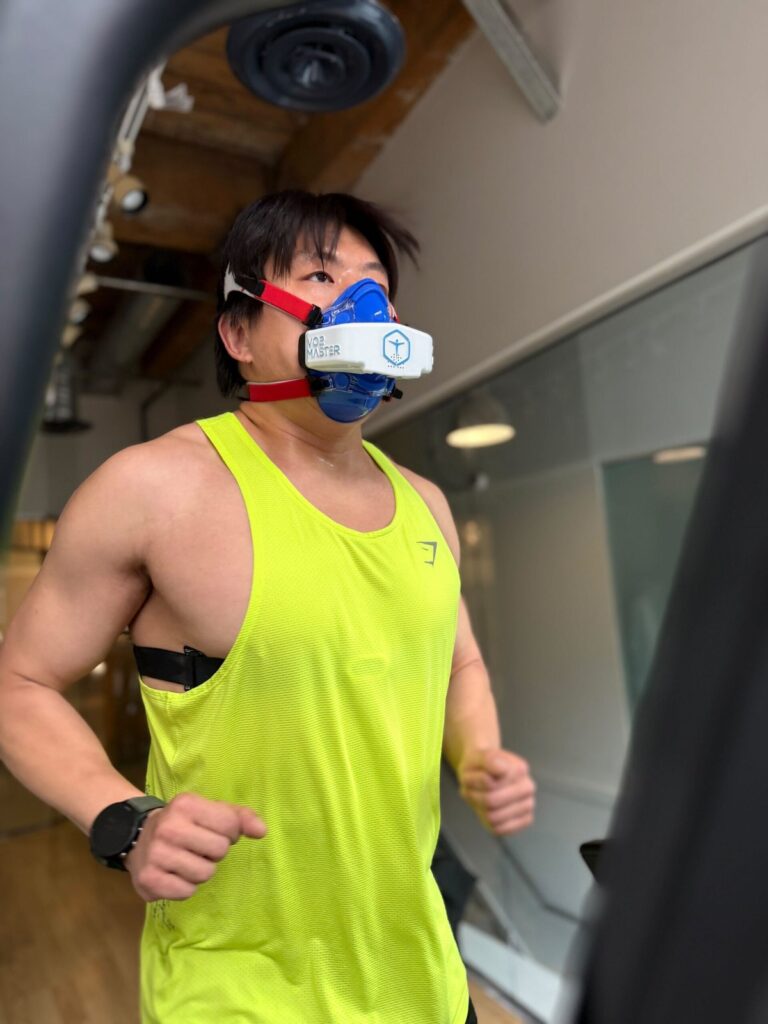
VO2 Max Testing in Vancouver, Done Properly.
Metabolic cart, graded protocol, full report walkthrough — 45 minutes from arrival to debrief. The strongest single predictor of longevity, on the books in your dashboard.
Book a Vancouver VO2 MaxIf you’ve ever read about VO2 max as the strongest predictor of longevity and wondered where to actually get it tested in Vancouver, you’ve probably found mostly research labs and university physiology departments — not exactly walk-in friendly. We do VO2 max testing in Vancouver at our Gastown studio with a metabolic cart and a graded protocol, in about 45 minutes, for the price of a decent dinner. Here’s what to expect.
- VO2 max testing in Vancouver: BodyStats Gastown studio, by appointment.
- Test is 45 minutes total. The hard part is the last 60 seconds.
- You leave with VT1, VT2, VO2 max, percentile rank, and personalized training zones.
- Bookable online — no referral, no phone tag.
What we actually measure
A VO2 max test is the gold standard of cardiorespiratory fitness assessment. You wear a mask connected to a metabolic cart, exercise on a treadmill or bike at progressively higher intensities, and the machine measures the volume of oxygen you consume and CO₂ you exhale at each stage. From that, we calculate:
- VO2 max — your maximum oxygen uptake in ml/kg/min. The headline number.
- VT1 (aerobic threshold) — the intensity above which you start using significantly more carbohydrate. Useful for endurance training.
- VT2 (lactate / anaerobic threshold) — the intensity above which lactate accumulates faster than you can clear it. Roughly the limit of sustainable hard effort.
- HR at each threshold — heart rate values you can use to set training zones on your watch.
- Maximum heart rate, ventilation, breathing frequency, and tidal volume. Useful for diagnosing breathing limitations and training response.
For an estimate before you test, our VO2 max calculator uses the Cooper test or resting heart rate method to give you a starting number.
Why it’s worth doing
The 2018 JAMA paper by Mandsager et al. tracked 122,000 patients across two decades. Each one-unit higher VO2 max was associated with a 9% lower all-cause mortality. People in the lowest fitness quintile had 5× the mortality of the highest quintile.
Stronger effect than smoking, diabetes, or end-stage kidney disease — combined. Boosting VO2 max with deliberate training is one of the highest-leverage things you can do for long-term health.
What the test is like
Walking through the appointment:
- Setup (10 minutes). You arrive in workout clothes. We fit a VO2 mask, calibrate the gas analyzer, and review your medical questionnaire.
- Warm-up (3–5 minutes). Easy walking on the treadmill or low-watt cycling.
- Graded protocol (8–15 minutes). Effort increases every 1–3 minutes. Each stage gets harder until you reach voluntary exhaustion.
- Cooldown and debrief (10–15 minutes). Easy movement, water, and a walkthrough of every number on your report.
The hard part is the last 60–90 seconds — they require going to the limit of your effort. Everything before is uncomfortable but manageable. We coach you through it.
Total appointment: about 45 minutes. You leave with a full PDF report — and your scan logs to your BodyStats dashboard so you can track VO2 max over time alongside body composition.
How to prepare
- Skip caffeine for 4 hours before the test. It alters heart rate and gas exchange.
- Eat a light meal 2–3 hours before. Don’t test on a full stomach or completely empty.
- Hydrate normally. Don’t carb-load or drink a litre of water in the hour before.
- Rest the day before. No high-intensity training the day before; easy training the day of is fine.
- Wear actual workout clothes — moisture-wicking shirt, athletic shorts or tights, supportive shoes.
What your result means
Your VO2 max number sits on a scale roughly like this for adults:
| Category | Men 30–39 | Women 30–39 |
|---|---|---|
| Below average | < 41 | < 32 |
| Average | 42–48 | 33–37 |
| Above average | 49–53 | 38–42 |
| Excellent | 54–58 | 43–47 |
| Elite | > 58 | > 47 |
The mortality benefit isn’t linear — most of the improvement comes from moving from “below average” to “average,” not from “above average” to “elite.” If you’re in the bottom quintile, the easiest 20% of training effort gives you the biggest absolute health return.
Frequently asked questions
Where in Vancouver can I get a VO2 max test?
BodyStats Vancouver at 316 Carrall Street in Gastown. Some sports medicine clinics and university physiology departments also offer testing — typically by appointment, at 2–3× our price.
How much is a VO2 max test in Vancouver?
See our pricing page for current rates. We’re typically the most affordable option in the city.
Do I need to be in shape to do the test?
No. The protocol is graded — it ramps to your individual maximum. Beginners hit exhaustion at lower stages; trained athletes go further.
Should I do a DEXA scan and a VO2 max test together?
Yes, if you can. The two measure different things — body composition vs cardiovascular fitness — and together give you the full picture. Bundle them via our packages.
How often should I retest?
Every 12–16 weeks if you’re actively training to improve VO2. Every 6–12 months otherwise. The number changes slowly enough that more frequent testing isn’t useful.
Test the most important fitness number you have.
VO2 max test in Vancouver — Gastown studio, full report, training zone walkthrough, dashboard tracking.
Book a VO2 Max Test