

The Cooper Test for VO2 Max.
The classic 12-minute run test, the equation behind it, and how to do it well — plus when to graduate to a real lab test instead.
Use the CalculatorThe Cooper test is the OG VO2 max field test. Designed in 1968 by Dr Kenneth Cooper for the US Air Force, it’s still the most accessible way to estimate your VO2 max without any lab equipment — just a track, a watch, and 12 minutes of pain. Here’s how to run it, the formula behind it, and how it stacks up against lab testing.
- Run as far as you can in 12 minutes. Distance in metres → estimated VO2 max.
- Formula: VO2 max ≈ (distance − 504.9) ÷ 44.73.
- Accuracy is roughly ±10–15% versus lab testing.
- Best for trained runners on flat surfaces; less reliable for non-runners.
How to run the Cooper test
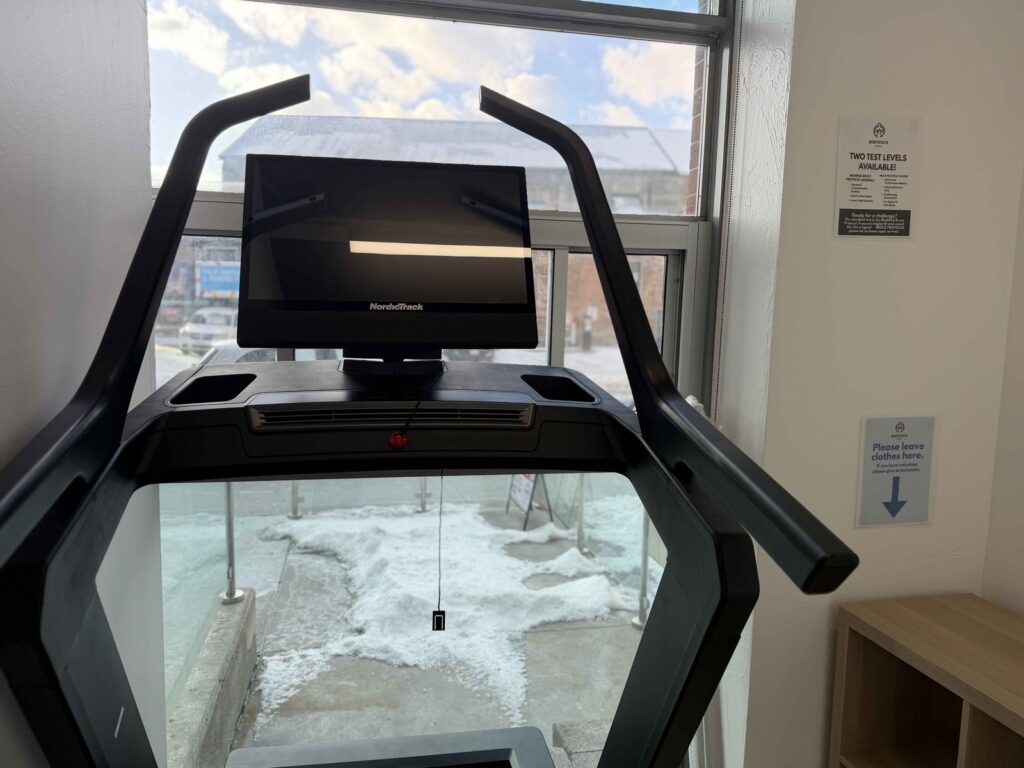
- Pick a flat surface. A 400-metre track is ideal. Treadmill works but reads slightly different.
- Warm up properly. 10 minutes of easy jogging plus a few strides. Don’t skip this.
- Run for exactly 12 minutes as far as you can. Pacing matters — start steady, finish hard.
- Record total distance in metres.
- Plug into the formula: VO2 max = (distance − 504.9) ÷ 44.73.
Or skip the math and use our VO2 max calculator — it includes the Cooper test plus a few alternatives (Rockport walk, resting heart rate methods).
What the result actually means
| Distance (m) | Estimated VO2 max | Category (men 30s) |
|---|---|---|
| 1,600 | ~24 | Poor |
| 2,000 | ~33 | Poor |
| 2,400 | ~42 | Average |
| 2,800 | ~51 | Above average |
| 3,200 | ~60 | Excellent |
| 3,600+ | ~69+ | Elite |
The Cooper test rewards pacing as much as fitness. Two athletes with the same true VO2 max can produce 200–300 metres of difference based on how they pace the 12 minutes.
How accurate is it?
The Cooper formula is empirically calibrated — it works well on average, less well at the edges. Trained runners with good pacing typically come within 10% of lab values. For people who don’t run regularly, the test underestimates because pacing inefficiency drags down the result.
Compare with other field methods:
- Rockport walk test — for non-runners. Walk a mile as fast as you can, plug heart rate into a different formula. Accuracy similar to Cooper for sedentary populations.
- Resting heart rate method — calculates VO2 max from HR rest, age, and HR max. Quick but less precise than Cooper.
- Garmin / Apple Watch estimates — use HR-vs-pace data over time. Decent for tracking change; can drift 5–10% from absolute truth.
When to skip the field test
The Cooper test is a free way to get a number. A real lab test is more accurate, gives you VT1 and VT2 thresholds (not just max), and translates into actual training zones for your watch. Reach for it when:
- You want to set training zones, not just a number.
- You’re tracking small (1–3%) changes over training blocks.
- You suspect your watch estimate is wrong.
- You want age- and sex-matched percentile context, plotted against research norms.
Our VO2 max test at BodyStats covers all of the above in 45 minutes.
How to improve your Cooper number
- Build a Zone 2 base. 3+ hours of easy aerobic work weekly.
- Add weekly intervals. 4 × 4 min at hard effort, 3 min easy between.
- Practice pacing. Run 12-minute time trials every 4 weeks. Even pacing beats blowing up at minute 8.
- Strength training. Stronger legs translate into faster running for the same heart rate.
Frequently asked questions
Can I do the Cooper test on a treadmill?
Yes, but treadmill VO2 reads about 5% lower than track VO2 because there’s no wind resistance. Set 1% incline to compensate.
How often should I retest?
Every 4–6 weeks if you’re actively training. The number should improve in that window.
Should I do the Cooper test in the heat?
No. Heat raises heart rate and degrades performance. Test in cool, dry conditions for the most repeatable number.
What’s a “good” Cooper distance?
For a 30-year-old man, 2,800 metres is above average. For a 30-year-old woman, 2,400 metres. See the full norms table above.
Want the real number?
Book a VO2 max test at BodyStats Vancouver or Toronto. Lab-grade accuracy, full report, training zones.
Book a VO2 Max Test