

VO2 Max Charts by Age and Sex.
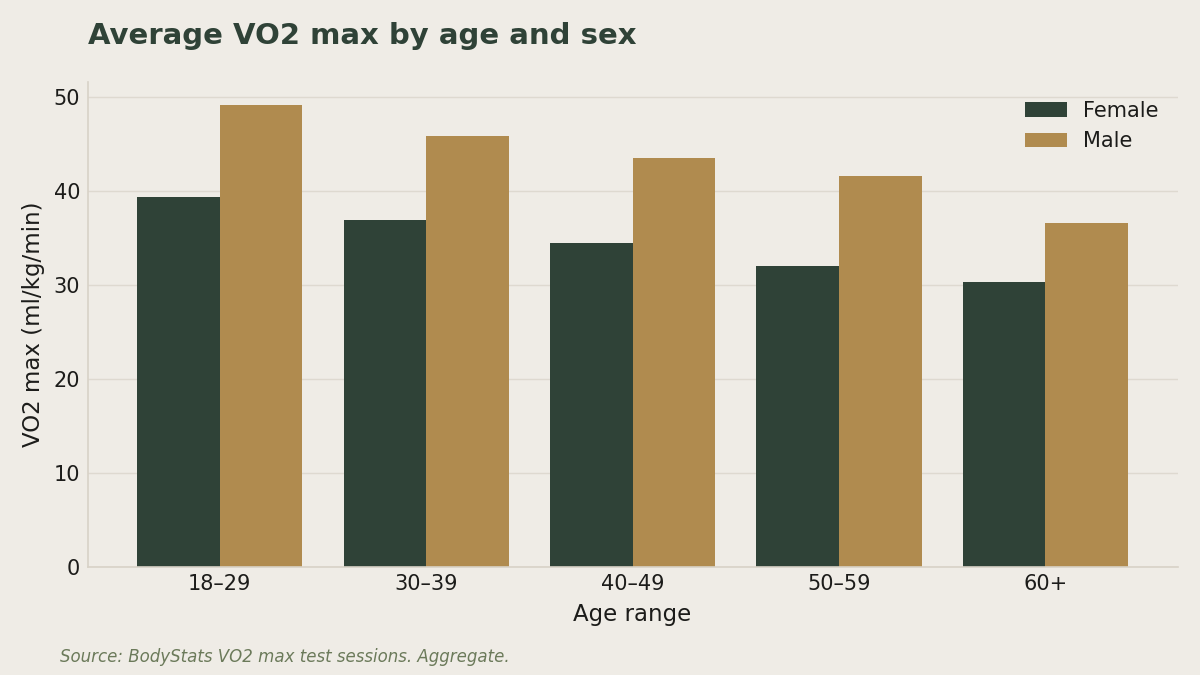
Got your number and don’t know what to do with it? Where you fall in age- and sex-matched bands is what matters. Here’s what 1,081 of our clients show, plotted against research norms.
Try the CalculatorVO2 max in isolation is just a number. What matters is where it sits relative to people your age and sex — and whether it’s trending up or down for you specifically. We pulled 1,081 BodyStats VO2 max test sessions and broke them down by age and sex so you can see exactly where you fall, then translated that into the percentile bands and longevity context that make the number useful.
- VO2 max is meaningful only against age- and sex-matched norms.
- BodyStats male average: 36.6–49.1 ml/kg/min depending on age. Female average: 30.3–39.3.
- Untrained adults lose ~10% per decade after 30. Active adults lose ~5%.
- The mortality benefit isn’t linear — moving from “below average” to “average” is the highest-leverage shift.
What VO2 max measures (briefly)
VO2 max is the maximum oxygen your body can use during exercise, in ml/kg/min. It’s the integrated function of your heart, lungs, blood, vasculature, and mitochondria. The single strongest predictor of all-cause mortality we have — stronger than smoking history, blood pressure, or diabetes (Mandsager et al., JAMA 2018).
What our data shows
VO2 max norms by age (men)
| Category | 20–29 | 30–39 | 40–49 | 50–59 | 60+ |
|---|---|---|---|---|---|
| Poor | < 38 | < 35 | < 32 | < 28 | < 24 |
| Below avg | 38–43 | 35–41 | 32–38 | 28–34 | 24–30 |
| Average | 44–50 | 42–48 | 39–44 | 35–40 | 31–35 |
| Above avg | 51–55 | 49–53 | 45–49 | 41–45 | 36–40 |
| Excellent | 56–60 | 54–58 | 50–54 | 46–50 | 41–45 |
| Elite | > 60 | > 58 | > 54 | > 50 | > 45 |
VO2 max norms by age (women)
| Category | 20–29 | 30–39 | 40–49 | 50–59 | 60+ |
|---|---|---|---|---|---|
| Poor | < 30 | < 27 | < 25 | < 22 | < 19 |
| Below avg | 30–34 | 27–32 | 25–29 | 22–26 | 19–23 |
| Average | 35–40 | 33–37 | 30–34 | 27–31 | 24–28 |
| Above avg | 41–45 | 38–42 | 35–40 | 32–36 | 29–33 |
| Excellent | 46–50 | 43–47 | 41–45 | 37–41 | 34–38 |
| Elite | > 50 | > 47 | > 45 | > 41 | > 38 |
The mortality data shows the biggest absolute risk reduction comes from moving “poor” to “below average” — not “above average” to “elite.” If you’re starting low, the easiest 20% of training effort is the highest-leverage health move you’ll make this year.
How VO2 max declines with age
Untrained adults lose roughly 1% of VO2 max per year after 30 — about 10% per decade. Active adults lose closer to 5% per decade. Athletes who deliberately train into their 50s and 60s often hold within 5–10% of their peak number.
The compounding matters. A 30-year-old man at 50 ml/kg/min who does nothing about it will drift to ~35 by 60 — into “below average” territory. The same person who keeps training will end up at 45 — still “above average.” Same starting point, very different mortality risk.
What to do with your number
- If you’re “poor” or “below average”: Build a Zone 2 base. 3 hours/week of easy aerobic work. Add a single weekly VO2 interval session (4 × 4 min at 90–95% HR max). Expect 10–15% gains in 12 weeks.
- If you’re “average”: Add a second interval session weekly. Mix Zone 2 long runs with threshold work.
- If you’re “above average”: The gains get harder. Focus on consistency, not heroic blocks. Strength training matters more than you think.
- If you’re “excellent” or “elite”: You probably know more about training than this article. Don’t lose what you have.
To estimate without testing: our VO2 max calculator uses the Cooper test, Rockport walk test, or resting heart rate to give you a number to test against.
Frequently asked questions
How accurate are calculator estimates vs lab tests?
Calculator estimates are typically within 10–15% of lab values for trained individuals, less reliable for untrained. The lab test is the truth.
Why does my Garmin say my VO2 max is different?
Watches estimate VO2 max from heart-rate-vs-pace patterns and may be off by 5–10%. Useful for tracking changes in your number over time, less useful as an absolute baseline.
Should I worry if I’m “below average” for my age?
It’s the easiest level to improve from. 8–12 weeks of structured training typically moves you up a category.
What’s a sample VO2 max report look like?
See our sample VO2 max report for the full output of a real test.
Find your real number.
Book a VO2 max test at BodyStats Vancouver or Toronto. Lab-grade testing, full report, training-zone walkthrough.
Book a VO2 Max Test