

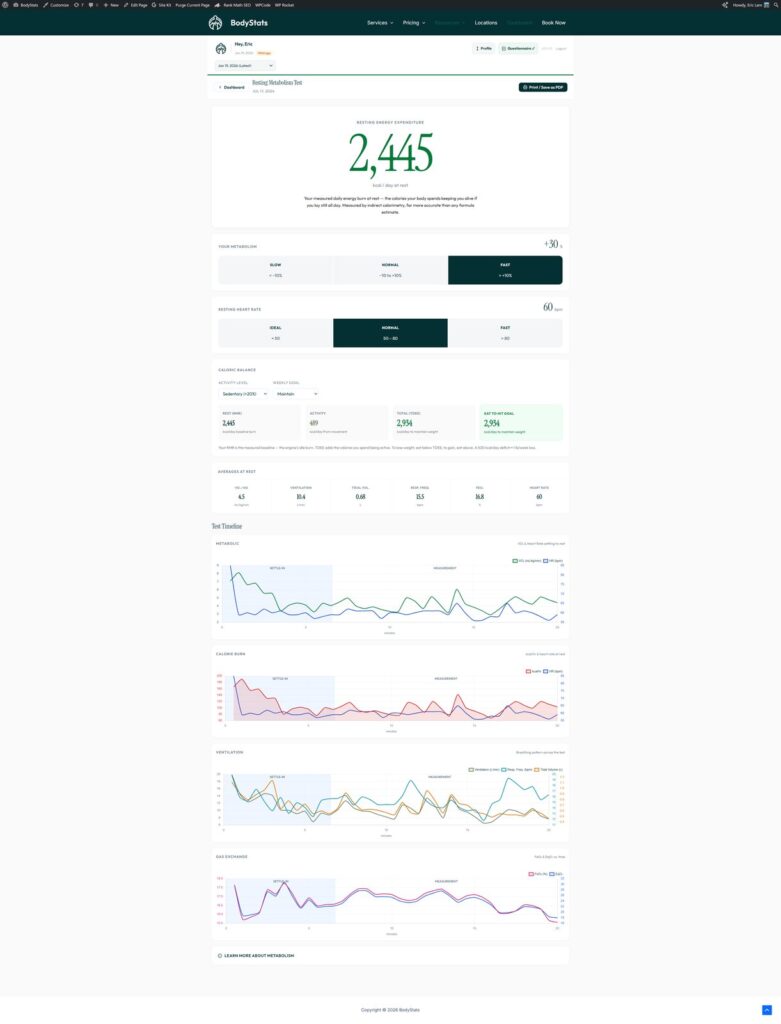
Three Numbers Everyone Confuses.
BMR, RMR, TDEE — they sound interchangeable. They’re not. Each measures something different, and using the wrong one is why most calorie targets are off by 200–500 calories a day.
Use TDEE CalculatorIf you’ve ever set a calorie target from an online calculator and wondered why you weren’t losing weight at the rate it predicted, the problem is usually that the calculator gave you the wrong kind of number. BMR, RMR, and TDEE are not interchangeable. Here’s exactly what each measures and which one to use when.
- BMR: calories burned at complete rest, lab-controlled. The lowest of the three.
- RMR: calories burned at rest, real-world conditions. ~5–10% higher than BMR.
- TDEE: total daily calories burned, including activity. The number you actually eat against.
- Most “calorie calculators” estimate BMR or RMR. You need TDEE.
BMR — Basal Metabolic Rate
BMR is the energy your body uses to keep you alive in the most controlled possible state: lying down, fully reclined, in a thermoneutral room, after a 12-hour fast, no recent exercise, no caffeine, often early morning right after waking.
It’s a research-grade measurement. Most people will never have a true BMR measured because the conditions are impractical. The Harris-Benedict and Mifflin-St Jeor equations you see online are predictions of BMR from population averages.
RMR — Resting Metabolic Rate
RMR is BMR’s practical cousin. Same idea — calories burned at rest — but measured under real-world conditions: lying or sitting still for 15–20 minutes, in a comfortable room, recent meal allowed, after maybe a 4-hour fast.
RMR runs about 5–10% higher than true BMR because of the looser conditions. In practice, RMR and BMR are used interchangeably outside research labs. When somebody says “your basal metabolic rate,” they almost always mean RMR.
Our RMR test guide covers measurement methods (metabolic cart vs DEXA-derived) and why both are useful.
TDEE — Total Daily Energy Expenditure
TDEE is the full picture: RMR plus everything else you do during the day. It includes:
- RMR — 60–70% of TDEE for most people.
- NEAT (Non-Exercise Activity Thermogenesis) — fidgeting, walking around, daily movement. 15–30%.
- EAT (Exercise Activity Thermogenesis) — deliberate workouts. 5–15%.
- TEF (Thermic Effect of Food) — the calories your body burns digesting. ~10%.
TDEE is the number you actually need for nutrition planning. Eat below it to lose weight, above it to gain.
Quick comparison
| Number | What it measures | How to find it | Use it for |
|---|---|---|---|
| BMR | Calories at full rest, lab-controlled | Predicted by formula | Research baseline (rarely) |
| RMR | Calories at rest, real-world | Metabolic cart or DEXA-derived | Cut-floor calorie target |
| TDEE | Total daily calories burned | RMR × activity multiplier | Maintenance calorie target |
Most online calculators give you BMR or RMR and call it “your daily calories.” It isn’t. You eat at TDEE; you cut from TDEE; you bulk above TDEE. RMR is just the floor.
How to use each number
For maintenance (eat at TDEE)
Multiply your RMR by an activity multiplier:
- 1.2: Sedentary (desk job, minimal movement).
- 1.375: Light activity (commute walking, occasional gym).
- 1.55: Moderate (3–5 workouts/week).
- 1.725: Active (daily training, physical job).
- 1.9: Very active (athlete, manual labour + training).
For fat loss
Eat 300–500 calories below TDEE for ~1 lb/week loss. Don’t go below RMR — that’s where adaptive thermogenesis (your body slowing down) starts kicking in.
For muscle gain
Eat 200–400 calories above TDEE with adequate protein (~0.8 g per lb of bodyweight). Track lean mass via DEXA every 8–12 weeks to confirm you’re gaining muscle, not just fat.
Why your “real” RMR matters
The Mifflin-St Jeor formula online estimates RMR from age, sex, height, and weight. It assumes population-average lean mass. If you have less muscle than average (most desk workers), your real RMR will be lower than the calculator’s guess. If you have more muscle (most lifters), it’ll be higher.
The 100–200 calorie error from a population formula compounds across a year. For a real RMR, get a DEXA-derived measurement (included with every BodyStats scan) or a metabolic cart test.
Frequently asked questions
Should I use BMR or RMR for fat loss?
Use RMR. BMR is theoretical; RMR is what your body actually burns at rest. Eat at TDEE − 300 to 500. Don’t go below RMR.
How accurate is an online TDEE calculator?
Within 10–15% for population averages. The error comes from the activity multiplier (which is a guess) and the predicted RMR (which assumes average lean mass).
Does TDEE drop when I diet?
Yes — by 5–15% over a long cut. Adaptive thermogenesis lowers RMR + reduces NEAT (you fidget less, walk slower). Re-test RMR every 8–12 weeks during a long cut.
What’s the difference between RMR and metabolism?
“Metabolism” is colloquial; it usually means RMR or TDEE. There’s no separate medical thing called “your metabolism” — it’s all just calorie expenditure.
Get your real RMR.
DEXA-derived RMR included with every BodyStats scan from $29.99. Direct metabolic-cart testing also available.
Book a Scan