

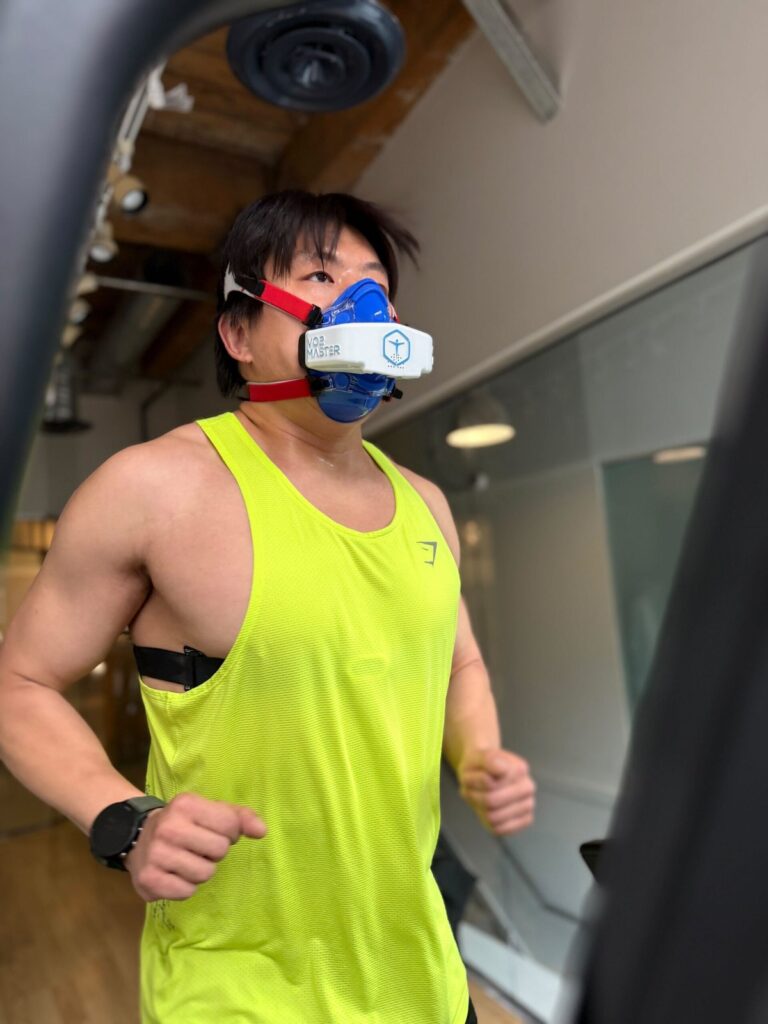
VO2 Max: The One Number That Predicts How Long You’ll Live.
Stronger predictor of mortality than smoking, diabetes, or end-stage kidney disease — combined. And, conveniently, dramatically improvable. Here’s what it is and how to test yours.
Book a VO2 Max TestIf you had to pick one number to predict how long someone will live, you would not pick their cholesterol, their blood pressure, or even their resting heart rate. You would pick their VO2 max. A 2018 JAMA study following 122,000 patients found that low cardiorespiratory fitness was a stronger predictor of mortality than smoking, diabetes, or end-stage kidney disease — combined. A VO2 max test measures yours directly, and unlike most longevity markers, this one is dramatically improvable.
- VO2 max is the maximum oxygen your body can use during exercise — the gold standard of cardiovascular fitness.
- Each one-unit improvement in VO2 max is associated with a 9% lower mortality risk (Mandsager et al., JAMA 2018).
- Average BodyStats VO2 max: men 36.6–49.1, women 30.3–39.3 ml/kg/min, declining with age.
- You don’t need to be an athlete to test or improve. The biggest gains come from people starting below average.
What VO2 max actually measures
VO2 max is the maximum volume of oxygen (V̇O₂) your body can take in, transport, and use during maximum-effort exercise. It’s expressed in milliliters of oxygen per kilogram of body weight per minute (ml/kg/min). The number captures the integrated function of your heart, lungs, blood, blood vessels, and muscle cells working together.
Two reasons it matters so much:
- It’s a downstream measure of everything that keeps you alive. Heart can’t pump enough blood? VO2 drops. Lungs can’t move enough air? VO2 drops. Mitochondria too few? VO2 drops. The number reflects the whole system.
- It’s the strongest single predictor of all-cause mortality we have. Stronger than smoking history, stronger than blood pressure, stronger than diabetes. The Cleveland Clinic’s 122,000-patient study found people in the lowest fitness quintile had 5× the mortality of the highest quintile.
What our VO2 max test data shows
From 1,081 BodyStats VO2 max test sessions, here’s how cardiorespiratory fitness distributes by age and sex:
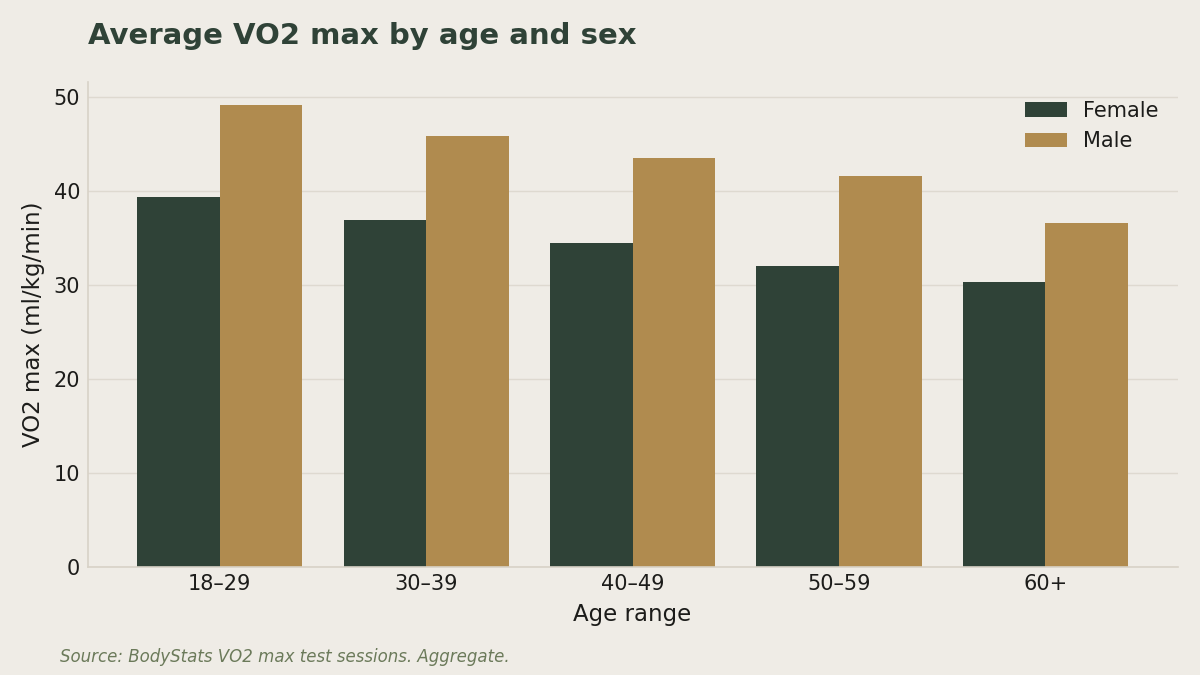
The decline rate matters. Untrained people lose roughly 10% of VO2 max per decade after 30. Active people lose closer to 5%. Athletes who train deliberately into their 50s and 60s often hold within 5–10% of their peak. The gap compounds.
What your VO2 max number means
For broad population norms, here’s where the lines fall:
| Category | Men 30–39 | Women 30–39 |
|---|---|---|
| Poor | < 35 | < 27 |
| Below average | 35–41 | 27–32 |
| Average | 42–48 | 33–37 |
| Above average | 49–53 | 38–42 |
| Excellent | 54–58 | 43–47 |
| Elite | > 58 | > 47 |
The mortality data shows the biggest absolute risk reductions come from moving from “poor” to “below average” — not from “above average” to “elite.” If you’re starting low, the easiest 20% of training effort gives you the biggest health return.
What happens during a VO2 max test at BodyStats
The test is more comfortable than its reputation suggests. Here’s the flow:
- Setup (10 minutes). You arrive in workout clothes. We fit a VO2 mask, calibrate the gas analyzer, and review your medical questionnaire.
- Warm-up (3–5 minutes). Easy walking or low-watt cycling to get your heart rate moving.
- Graded protocol (8–15 minutes). Effort increases every 1–3 minutes — typically by raising treadmill speed/incline or bike wattage. Each stage gets harder until you reach voluntary exhaustion.
- Cooldown and debrief (10–15 minutes). Gentle movement, water, and a walk-through of your VT1 (aerobic threshold), VT2 (lactate threshold), VO2 max, and recommended training zones.
Total appointment: about 45 minutes. The hard part is the last 60 seconds — it requires going to the limit of your effort. Everything before is manageable.
You leave with a full report covering training zones, VO2 max, percentile rank, ventilatory thresholds, and heart rate at each. Walk-through covers what numbers to use for which workouts — and your scan logs to your BodyStats dashboard so you can track VO2 max over time alongside body composition.
How to improve your VO2 max
The good news: VO2 max is one of the most trainable physiological markers. The bad news: training it requires actually being uncomfortable. The recipe that works:
- Zone 2 base (3–5 hours/week). Easy aerobic work. Conversational pace. Builds mitochondrial density and capillaries. Ideal: 60–70% of max heart rate. See our heart rate zones guide.
- VO2 max intervals (1–2 sessions/week). 4 × 4-minute intervals at 90–95% of max heart rate, with 3-minute easy recoveries. The classic Norwegian protocol. Brutal, effective, time-efficient.
- Strength training (2–3 sessions/week). Stronger leg muscles improve VO2 by raising the ceiling of how much oxygen you can use during exercise.
- Patience. Most people see 5–15% VO2 max gains in 12 weeks of consistent training. Untrained beginners can see more.
To estimate your starting VO2 without testing, our VO2 max calculator uses validated formulas (Cooper test, Rockport walk test, resting heart rate) to give you a number to test against.
Frequently asked questions
How long does a VO2 max test take?
About 45 minutes total — 10-minute setup, 8–15 minutes of graded exercise, 10–15-minute cooldown and report walkthrough.
Do I need to be in shape to do a VO2 max test?
No. The test is graded — it starts easy and ramps up to your individual maximum. Beginners reach exhaustion at lower stages; trained athletes go further. The test ends when you end it.
What’s the difference between VO2 max and VO2 sub-max testing?
Sub-max tests use heart-rate response to predict VO2 max without requiring maximum effort — useful for people with cardiovascular contraindications. They’re roughly 80% as accurate. We default to true max protocol unless there’s a reason not to.
Should I do a VO2 max test or a DEXA scan first?
If you only do one, do DEXA — body composition is more actionable for most people. If you can do both, do them in the same week so the readings reflect the same body. Many of our clients bundle the two.
What does a sample VO2 max report look like?
See our sample VO2 max report — a real, full-length walk-through of what you’d get after testing.
Test the most important fitness number you have.
Book a VO2 max test at BodyStats Vancouver or Toronto. Full report, training-zone walkthrough, and a baseline you can improve.
Book a VO2 Max Test