
What’s a good VO2 Max for your age?
A score only becomes useful when you put it in context. Compare your result with directly measured reference data for your age, reference sex, and testing method—then learn what the number means for your health and training.
Find your VO2 Max percentile
Use the same exercise mode as your test. Treadmill and cycle scores are not interchangeable.
Enter your result
We’ll compare it with adults in the same decade, reference-sex category, and exercise mode.
—
VO2 Max charts by age and reference sex
Percentiles are more useful than vague labels such as “good” or “poor.” They show where a directly measured result sits within a relevant comparison group.
| Age | 25th | Median | 75th | 90th |
|---|
Source: 2022 FRIEND standards using maximal tests with respiratory exchange ratio ≥1.10. Values are rounded to one decimal.
What does VO2 Max measure?
VO2 Max is the greatest rate at which your body can take in, transport, and use oxygen during intense exercise.
Lungs
Oxygen enters the lungs and moves into the bloodstream.
Heart and blood
Your cardiovascular system delivers oxygen to working tissue.
Muscle
Working muscles use oxygen to produce energy for movement.
The result is usually expressed as mL/kg/min. Age, reference sex, test method, body composition, genetics, training history, and sport can all influence the number.
A practical unit of cardiorespiratory fitness.
Fitness is associated with long-term health
A 2024 systematic review representing approximately 3.8 million observations found that each one-MET higher level of cardiorespiratory fitness was associated with 14% lower all-cause mortality risk and 16% lower cardiovascular mortality risk.
These are population-level associations. They do not predict an individual outcome or prove that a single change causes a specific reduction in risk.
Why test method changes your result
Treadmill values are generally higher than cycle values because more total muscle mass is active. Cycling results can also reflect leg-specific conditioning and familiarity with the movement.
Assault bike
Compare your result with cycle-ergometer reference values. Repeat testing on the same equipment for the cleanest progress comparison.
Treadmill
Compare your result with treadmill reference values. BodyStats Toronto uses a progressively harder treadmill protocol.
Athletes need a different comparison group
A result that is high for the general population may be ordinary in an endurance sport. These broad literature ranges are context—not targets or percentile standards.
| Sport | Typical age | Female range | Male range |
|---|---|---|---|
| Nordic skiing | 20–28 | 60–75 | 65–94 |
| Distance running | 18–39 | 50–75 | 60–85 |
| Rowing | 20–35 | 58–65 | 60–72 |
| Cycling | 18–26 | 47–57 | 62–74 |
| Soccer | 22–28 | 50–60 | 54–64 |
| Swimming | 10–25 | 40–60 | 50–70 |
| Basketball | 18–30 | 43–60 | 40–60 |
| Gymnastics | 18–22 | 36–50 | 52–58 |
Representative ranges compiled from published literature by INSCYD. Protocols, surfaces, exercise modes, athlete levels, and sample sizes vary, so these values should not be mixed with the FRIEND percentiles above.
VO2 Max and body composition
Relative VO2 Max divides oxygen use by total body mass. That means the score can change because aerobic capacity improved, body mass changed, or both happened together.
Relative VO2 Max
A score in mL/kg/min can rise if the same absolute oxygen uptake is divided by less body mass. That is mathematically real, but it is not automatically proof of cardiovascular adaptation.
DEXA context
A DEXA scan distinguishes fat mass, lean tissue, and bone. Paired with VO2 Max, it helps you interpret performance changes without treating every kilogram as identical.
Direct testing vs. a smartwatch estimate
Measures respiratory gases
- Progressive maximal exercise protocol
- Breath-by-breath oxygen data
- VT1, VT2, and personalized zones
- Best for a defensible baseline
Predicts from proxy data
- Usually based on heart rate plus pace or power
- Depends on device algorithms and sensor quality
- Helpful for tracking general direction
- Best compared within the same device
How to improve your VO2 Max
The best plan depends on your starting point, health, sport, and available training time. These principles apply broadly.
Build consistency
Regular aerobic work creates the foundation for harder sessions.
Develop your base
Use sustainable moderate-intensity training to build aerobic volume.
Add intervals
Appropriately programmed hard efforts can provide a strong stimulus.
Recover well
Sleep, fuelling, stress, and easy days influence adaptation.
Retest consistently
Use the same mode and similar preparation after 8–12 weeks.
If you have cardiovascular symptoms, significant health concerns, or uncertainty about maximal exercise, speak with a qualified healthcare professional before testing or beginning vigorous training.
VO2 Max questions, answered
What is a good VO2 Max?
A “good” result depends on age, reference sex, and testing mode. A practical benchmark is the percentile: above the 50th percentile is above the median for the selected comparison group, while the 75th percentile or higher represents a high result relative to that group.
Why are treadmill and cycling values different?
Treadmill exercise generally recruits more total muscle mass and often produces a higher peak oxygen uptake. Cycling scores can also be affected by leg-specific conditioning. Compare a treadmill result with treadmill references and a cycling result with cycle references.
Does VO2 Max decline with age?
Population medians decrease across adulthood, but people of the same age vary widely. Physical activity and training status remain important, so an age-related trend is not the same as a fixed personal trajectory.
Is a smartwatch VO2 Max accurate?
A wearable usually estimates VO2 Max from heart rate, pace, or power rather than measuring respiratory gases. It can be useful for trends, but a direct test provides a stronger baseline and additional information such as ventilatory thresholds.
Can losing weight increase relative VO2 Max?
Yes. Because relative VO2 Max is divided by body mass, it may rise when body mass decreases even if absolute oxygen uptake stays the same. Body composition and absolute VO2 help explain what changed.
How often should I retest?
If you are following a focused training plan, 8–12 weeks is often enough time to look for a meaningful change. Retest with the same equipment, preparation, and protocol whenever possible.
What happens during a BodyStats test?
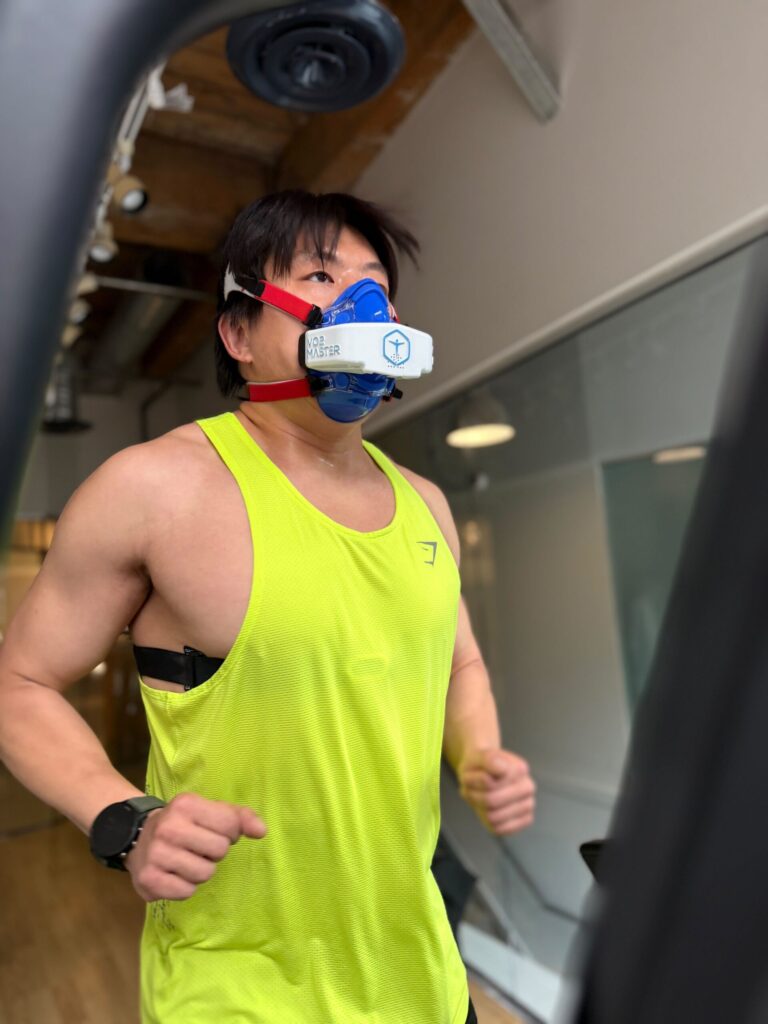
The appointment takes approximately 20 minutes, including a warm-up and progressively harder exercise. You wear a VO2 Master analyzer while oxygen consumption, heart rate, power, and breathing data are recorded. Your report is typically emailed within 1–2 hours.
Stop estimating. Measure it.
A BodyStats VO2 Max test measures your aerobic capacity and identifies the thresholds behind your most useful training zones.
- Direct VO2 measurement
- VT1 and VT2
- Five personalized zones
- Peak heart rate and power
- Detailed digital report
- Approximately 20 minutes
Cycle-specific direct testing with the VO2 Master analyzer.
Progressive treadmill testing with the VO2 Master analyzer.
Sources and methodology
- Kaminsky LA, Arena R, Myers J, et al. Updated Reference Standards for Cardiorespiratory Fitness Measured with Cardiopulmonary Exercise Testing. Mayo Clinic Proceedings. 2022;97(2):285–293.
- Peterman JE. FRIENDanalysis percentile implementation. Reference edition 2, maximal tests with RER ≥1.10.
- Laukkanen JA, et al. Comparison of objectively measured and estimated cardiorespiratory fitness to predict mortality. Systematic review and meta-analysis.
- INSCYD. Representative athlete VO2 Max ranges by sport. Used only for the illustrative sport section.
Educational information only. This page does not provide medical advice, diagnose disease, or replace assessment by a qualified healthcare professional. Reference values are population summaries and may not represent every health condition, ethnicity, athlete population, or testing protocol.