

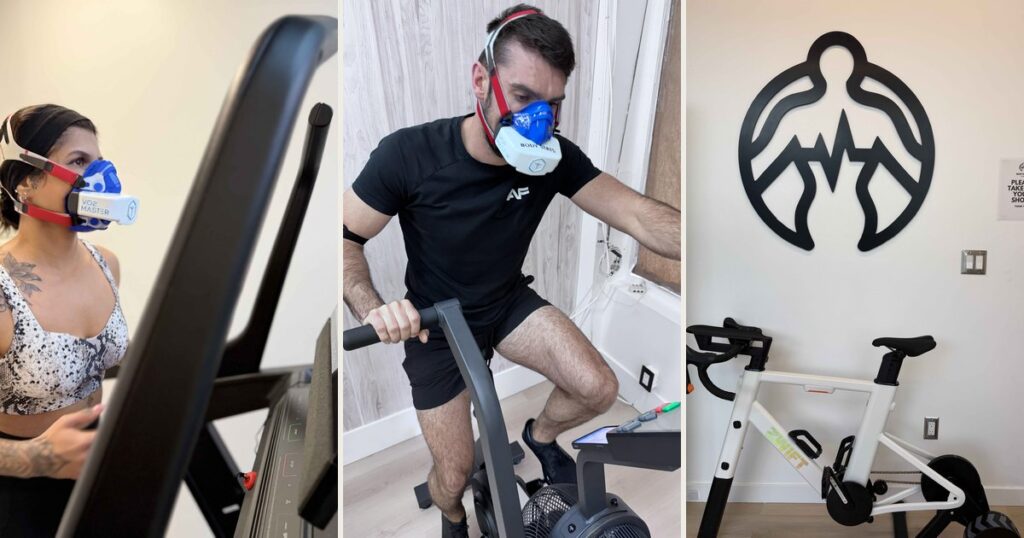
When you book a VO2 Max test, you choose a machine: a treadmill, a Zwift bike or an Air Bike. That choice changes your number. Here is why, which one to pick, and the one rule that keeps your progress honest.
For most people who are not cyclists, a treadmill test reads roughly 5 to 10% higher than a bike test. Neither result is wrong. Each one measures your fitness on a different movement, so compare yourself to yourself on the same machine.
Three ways to test
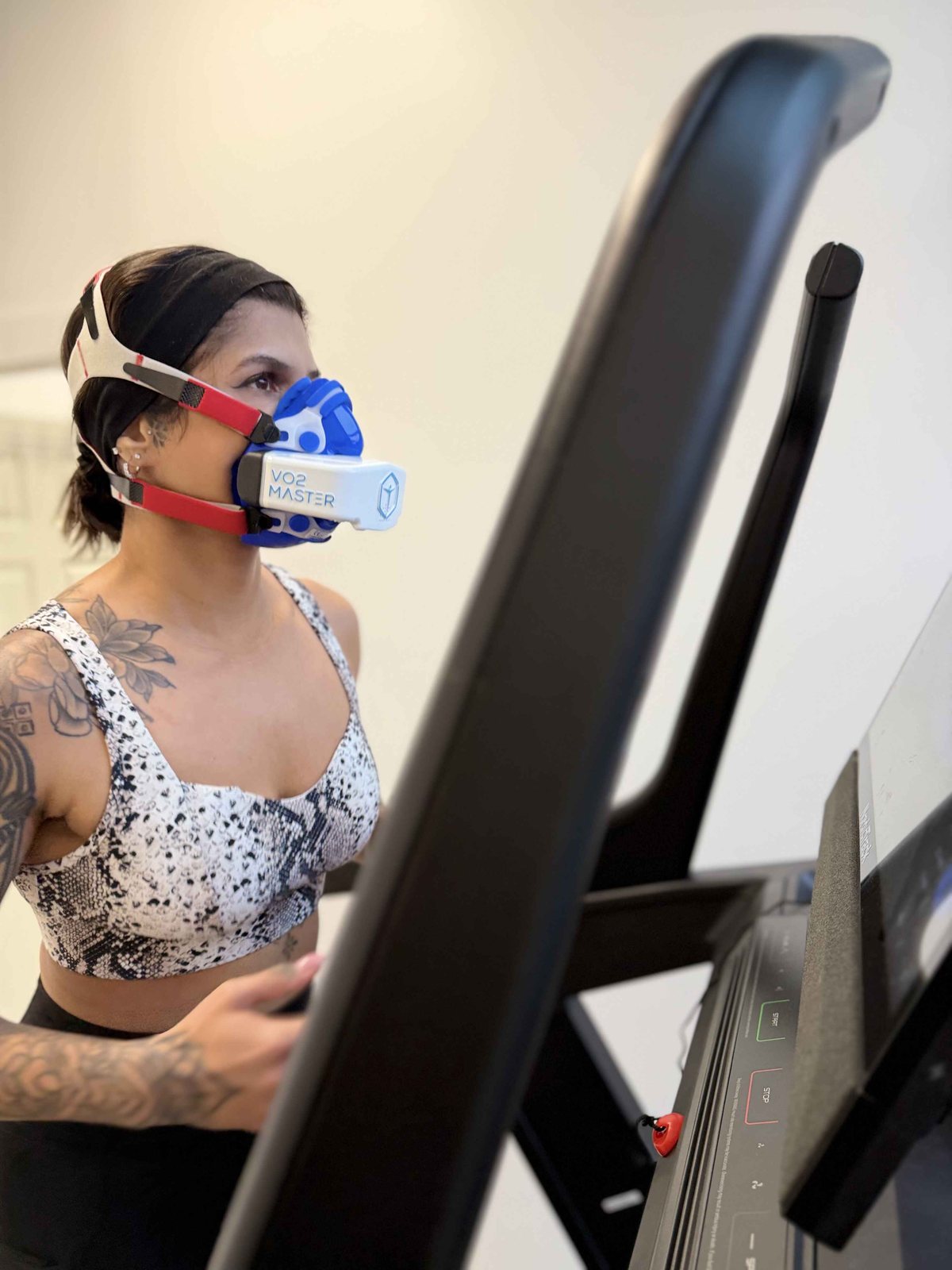
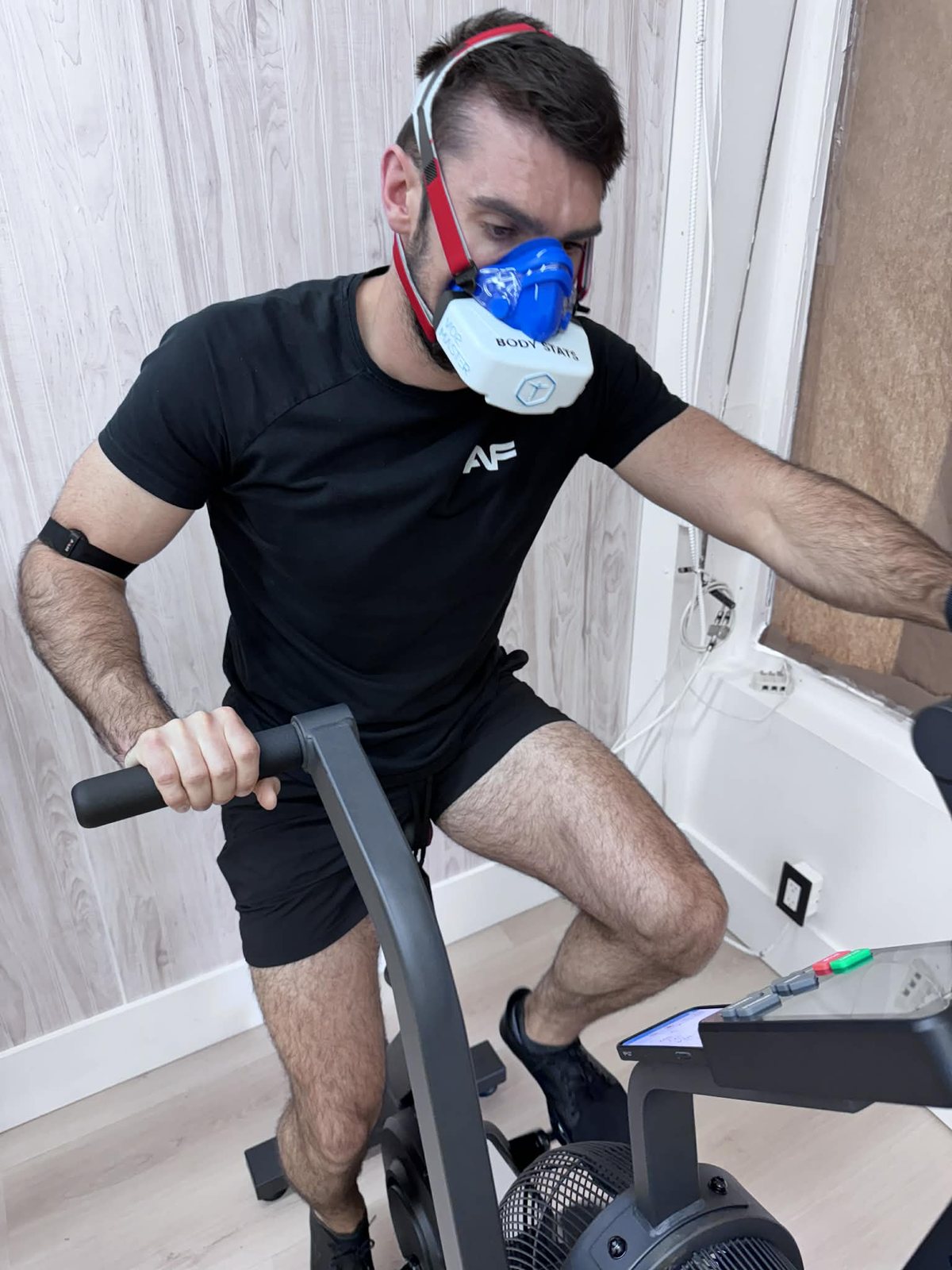
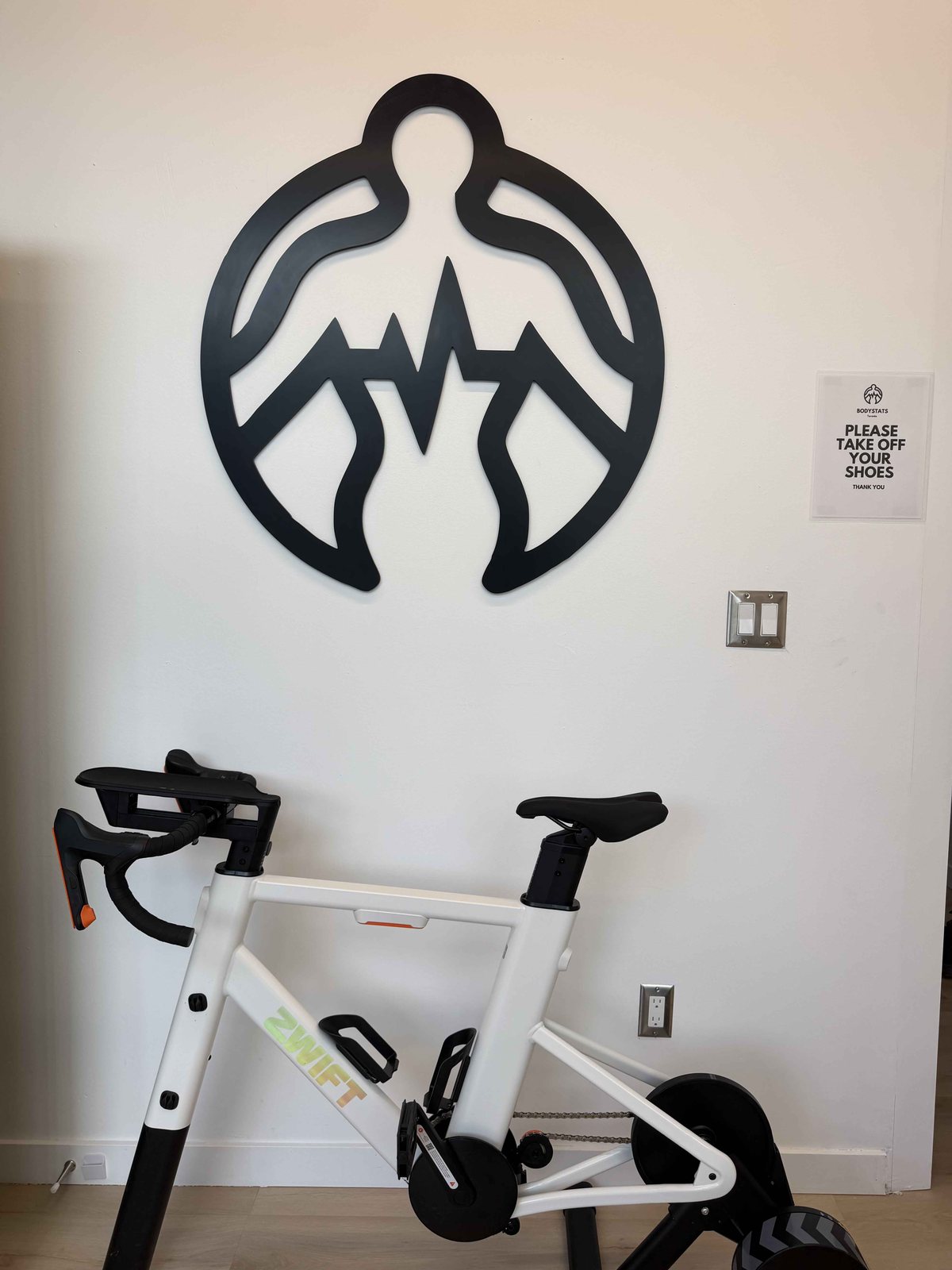
Every option uses the same mask and the same analysis. What changes is how much muscle is working and what tires out first.
Why the treadmill usually reads higher
VO2 Max is the most oxygen your body can use at full effort. To find it, a test has to push your heart and lungs to their ceiling before anything else gives out.
Running recruits more muscle. You carry your full body weight, your hips, legs and core all work, and your arms swing. More working muscle means more demand for oxygen, so your heart and lungs are usually the first thing to hit the limit.
Cycling concentrates the work in your thighs. On a bike, your quads do most of the job. In people who do not ride a lot, those muscles often burn out before the heart and lungs are fully maxed. The test ends a little early, and the number lands a little lower.
If you have ever finished a bike test thinking “my legs gave out before my breathing did,” that is exactly this effect. Lab studies comparing the same people on both machines have found the same pattern for decades.
When the bike is the better choice
A slightly lower number is not a worse test. For many people the bike gives a more useful result:
- You are a cyclist. Trained cyclists often score as high on a bike as on a treadmill, or higher. Your cycling zones will also be accurate for your rides.
- You are managing an injury. Foot, ankle, knee or back issues can make running all-out uncomfortable or risky. A bike takes the pounding out.
- You are newer to exercise, or older. No impact, no balance challenge at top speed, and you can stop instantly.
- You want a baseline you can build on. The best test is the one you can repeat. A bike baseline you retest every few months tells you far more than a one-off treadmill number.
The Air Bike sits in the middle. Your arms push and pull while your legs pedal, so more muscle shares the load and your quads are less likely to quit first. It is low-impact like a bike and full-body like running, which is why we suggest it when neither running nor cycling is a clear strength.
Side by side
| Treadmill | Air Bike | Zwift Bike | |
|---|---|---|---|
| Typical reading | Highest for most non-cyclists | Usually between the two | Often a little lower, unless you ride |
| What usually ends the test | Heart and lungs | Heart and lungs, or whole-body fatigue | Leg fatigue, unless you ride |
| Impact | Weight-bearing | Low | Low |
| Best for | Runners and team-sport athletes | Mixed training, joint concerns, first tests | Cyclists and triathletes on the bike |
| Zones transfer best to | Running | General cardio | Cycling |
The rule that matters most: retest on the same machine
Switching machines between tests can look like progress, or a setback, that never happened. Moving from a bike to a treadmill can add a few points to your VO2 Max without any change in your fitness. Moving the other way can hide real improvement.
So pick the machine that fits your training, and keep using it for every follow-up. If your training changes, say you are switching from cycling to running, start a fresh baseline on the new machine and track from there.
It is the same principle we follow for body composition. See why different DEXA machines give different numbers.
Lactate testing works the same way
Lactate thresholds are just as specific to the movement. Thresholds and zones from a bike test belong to your riding, and a treadmill test belongs to your running. Pick the machine you want zones for. More on our lactate threshold test.
Quick picker
Common questions
Is a bike VO2 Max test accurate?
Yes. It accurately measures your VO2 Max on a bike. If you are not a regular cyclist it will usually read a bit lower than a treadmill test, because your legs may tire before your heart and lungs reach their limit.
How much higher is a treadmill VO2 Max?
For most people who are not cyclists, roughly 5 to 10%. Trained cyclists often see little or no difference, and some score higher on the bike.
Can I compare a bike result with a treadmill result?
Only loosely. There is no exact conversion for an individual, so for tracking progress, compare tests done on the same machine.
Which machine gives me the best training zones?
The one you train on. Running zones from a treadmill test, cycling zones from a bike test. Learn more in our heart rate zones guide.
Ready to find your number?
Book a VO2 Max test in Vancouver or Toronto. You choose the machine when you book.
This guide started with a question from a BodyStats client who trains on a bike to protect their feet. Thank you for asking it. See how your result compares in VO2 Max by age, sex and sport, or read how to improve your VO2 Max.
- Hermansen L, Saltin B. Oxygen uptake during maximal treadmill and bicycle exercise. Journal of Applied Physiology. 1969;26(1):31–37.
- Basset FA, Boulay MR. Specificity of treadmill and cycle ergometer tests in triathletes, runners and cyclists. European Journal of Applied Physiology. 2000;81(3):214–221.
- Millet GP, Vleck VE, Bentley DJ. Physiological differences between cycling and running: lessons from triathletes. Sports Medicine. 2009;39(3):179–206.